A religious painting is not a puzzle you need a theology degree to solve. Most of it is a code, and the code is small. A handful of saints, a dozen gestures, a few colors and objects cover the great majority of what hangs in a secular museum's medieval and Renaissance rooms. Learn the code, and a wall of anonymous altarpieces turns into a room of legible stories.
This guide walks through the most common signs: who the figures are, what their hands are saying, why the sky is gold, and what the lily, the lamb and the skull mean. None of it requires belief. The word itself helps here: to read, in its oldest English sense, has always meant to interpret — the Wiktionary entry traces the verb through Old English rædan, "to counsel, advise, consult; interpret, read." Reading a painting is reading in exactly that older sense. You are interpreting, not praying.
It also helps to remember why the code exists. For centuries most viewers could not read text, so painters put the story in objects instead. The picture was the paragraph. Museums preserve that visual language even when the faith that built it has receded from public life, and you can see the same instinct at work in other traditions — in the way Islamic calligraphy became sacred art, or how illuminated manuscripts packed meaning into every margin. For related coverage, see Why Islamic Calligraphy Became Sacred Art.
Who is that figure? Start with the props
The fastest way to identify a saint is to look at what they are holding. Art historians call these objects "attributes," and the system is wonderfully blunt. A saint's attribute is usually tied to how they died or what they did in life, so the object is a name tag and a biography at once.
Some of the most common ones:
- Keys — Peter, holding the keys to heaven's gate.
- Sword — often Paul, though a sword beside a bishop's hat means Thomas Becket.
- Arrows — Sebastian, shot and left for dead.
- Wheel — Catherine of Alexandria, condemned on a spiked wheel.
- Lamp or lantern — the parable of the wise virgins, or Diogenes-style searching, depending on the scene.
- Lily — purity, most often carried by the angel Gabriel in scenes of the Annunciation.
- Skull — a memento of death; it marks saints of penitence like Jerome or Mary Magdalene.
- Lamb — almost always Christ himself, under the image of the Lamb of God.
John the Baptist is easy: he wears animal skin and often points a long thin finger. Franciscan friars wear brown rope-belted robes; Dominicans wear black and white. Once you have matched a few attributes, the gallery stops being anonymous.
What are the hands saying?
Gestures carry as much meaning as objects. A raised right palm, fingers together, is blessing — the fingers may be arranged in a specific pattern that spells out Christ's initials in Greek. A hand held flat, palm outward, is a gesture of speech or oath-taking. Two fingers extended mean the two natures of Christ, divine and human, in much Western painting.
Watch the hands between figures, too. In an Annunciation, Mary's palm is usually open and turned toward the viewer or the angel: acceptance, or a question. In scenes of doubt, hands clutch, cover, or reach and stop short. Thomas reaching into Christ's wound is the most famous example, but the pattern is everywhere. If two figures mirror each other's gestures, the painter is usually telling you they belong together — consent, echo, or agreement.
Direction matters as well. In Western convention, figures on the viewer's left often read as the "old" order and those on the right as the "new," which is why the Annunciation so often shows Gabriel entering from the left. This is a convention, not a law, and individual painters break it constantly. Treat it as a hint rather than a rule.
Why is the sky gold, and what do the colors mean?
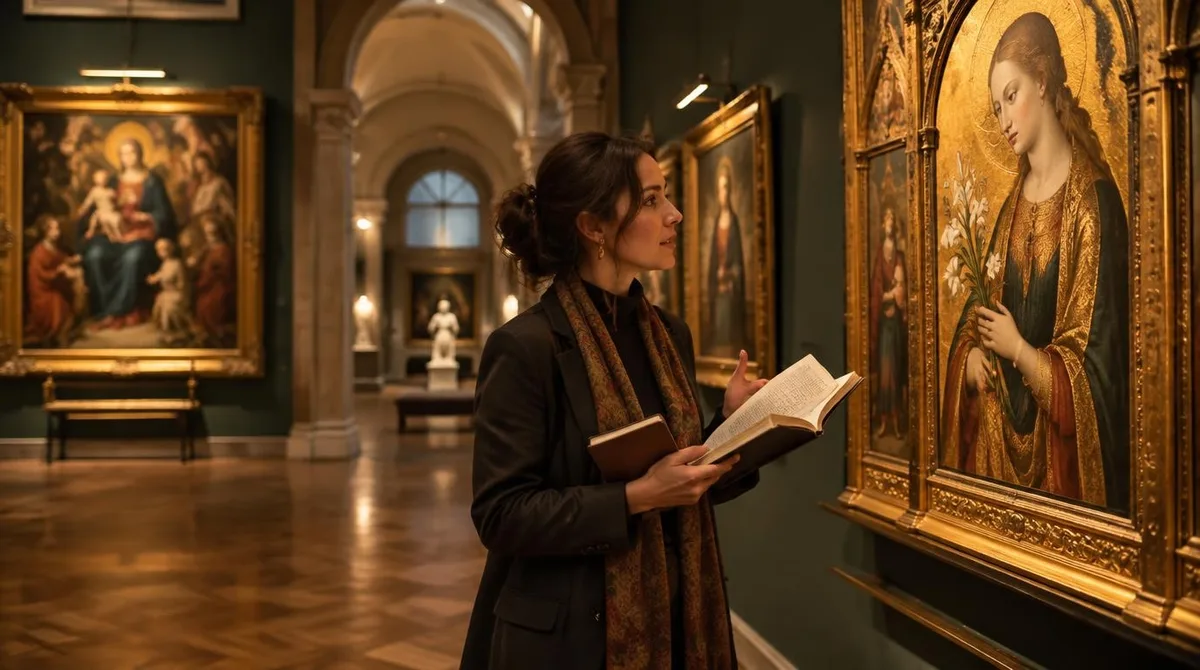
Gold backgrounds are not decoration. Gold signals a space outside ordinary time — heaven, eternity, a vision. When a Renaissance painter replaces the gold with blue sky, the event has moved into the human world. That single shift tells you more about the painting's ambitions than any wall label.
Colors carry set meanings too, though the meanings flex by region and century. Blue, made from costly ground lapis or the cheaper smalt, belongs to Mary in most Western painting; a large blue robe is one of the most reliable identifiers in the room. Red suggests blood, charity or martyrdom. White is purity. Purple marks royalty or penitence. Green can mean hope or, in darker scenes, the devil. Yellow, in some northern European painting, shades toward treachery — which is why Judas so often wears it.
The practical takeaway: if a color seems unusually expensive or unusually prominent, the painter is spending it on purpose. Ask what the brightest or costliest patch in the picture is, and what figure it touches.
Which scenes come up again and again?
A small set of stories fills most of the walls, so recognizing the scene does most of the interpretive work for you. The Annunciation shows two figures in a quiet room, one winged, often with a lily and a beam of light. The Crucifixion needs no introduction, but note the mourners: Mary and John flank the cross in a fixed pairing. The Pietà shows Mary holding the dead Christ after the descent from the cross. The Adoration of the Magi gathers three richly dressed men around a child, usually with a ruin or stable behind them — the ruin stands for the old order passing away.
Saints in wilderness, saints receiving visions, and martyrdoms make up most of the rest. If the scene shows a figure being killed in an inventive way, check the implement against the attribute list above; the instrument usually names the saint. The same logic of story-through-detail runs through manuscript painting, where the code is even denser — our primer on reading a Gothic cathedral covers the architectural version of the same system.
What this means for your museum visit
Here is a working method that fits any gallery visit, and it costs nothing but attention:
- Look at the hands first. Blessing, pointing, clenching, reaching — hands carry the sentence's verbs.
- Then the props. Match any object against the attribute list. One object usually names one figure.
- Then the colors. Find the most expensive color and ask who wears it.
- Then the setting. Gold means heaven; a landscape or an interior means the human world.
- Finally, read the label. Now the label confirms or corrects you, instead of doing all the work.
That last step is worth a pause. Museums have their own conventions for presenting sacred objects, and the framing on the wall shapes what you see as much as the frame on the canvas does. Our piece on how museums label sacred art looks at those choices, and the wider question of who gets to walk in is covered in What Culture Pass Programs Say About Museums.
One more habit helps: slow down. A gallery of religious painting rewards two pictures looked at for ten minutes each far more than twenty pictures glanced at. Pick a crowded scene and inventory it — every object, every hand, every color — and you will usually find a detail the label never mentions.
A closing thought on reading without believing
There is a real objection to all of this, and it deserves an honest answer. Reducing a devotional image to a code can flatten it. The painter was not making a crossword; the original viewers brought prayer, fear and hope to these pictures, and the code was scaffolding for that experience, not a substitute for it.
But the objection cuts the other way too. You cannot feel the weight of a picture you cannot read at all. Learning the symbols is not the end of looking — it is the entry fee. Once the figures have names and the gestures have meanings, the strange quiet of a museum's sacred wing becomes available to anyone, believer or not. The evidence for the code is on the walls themselves; the rest is attention. And attention, unlike belief, is something every visitor can bring.