Islamic calligraphy became the sacred art because of what it served: a revelation recited and fixed as a book. Writing the Quran beautifully was counted as devotion, while figuration was kept out of religious settings, so the energy other traditions spent on icons went into letterforms and gold. The proportional system credited to Ibn Muqla made it a science.
Why Writing Rather Than Images?
Because of where the restraint applied, not a blanket ban. The Quran itself contains no prohibition of images; the caution came from religious tradition — sayings that disapprove of image-making — and from custom that kept mosques and Quran codices free of figures, while courts and secular books used figuration freely.
In religious settings, ornament, geometry and above all writing carried the decoration; in courtly contexts, miniature painting flourished. The result was a hierarchy inverted relative to Christian Europe. There, the image argued theology; in the Islamic context, the word did — recited aloud with rules of tajwid, and written out with a care that made the script itself the religious visual tradition. Calligraphy was not a workaround for a missing picture cycle. It was the positive answer to the question of what the most beautiful thing on a page or a wall could be: the word it was made for.
How Did the Quran Become a Book?
Through two steps remembered in tradition. The revelations were written down during the Prophet's lifetime on whatever came to hand — palm stalk, bone, leather — and memorized; then, under the caliph Uthman (644–656), a standard recension was issued and copies sent to the cities, fixing the consonantal text. The form was the codex: parchment leaves bound at a spine.
The codex, replacing the scroll, followed the book convention of the region's older cultures. The earliest Quran scripts reflect that transition: a slanting hand modern scholars call Hijazi, then the square, monumental Kufic that carries the great early codices — including the famous Blue Quran, gold letters on parchment dyed deep indigo, now surviving as leaves scattered across collections. For three centuries the text and the script kept developing together, until copyists had at their disposal a family of hands with distinct uses and characters.
What Did Ibn Muqla Measure?
Letters, against each other. Ibn Muqla (886–940), three times vizier in Baghdad, is credited with al-khatt al-mansub, “proportioned writing”: every letter's height and curve derived from the rhombic dot of the nib and the height of the alif, so that a script becomes a set of ratios any trained hand can reproduce.
The tradition names two successors who perfected the system: Ibn al-Bawwab (died 1022) and Yaqut al-Musta'simi (died 1298). Proportion settled the script families into the roles they still hold. Naskh, compact and legible, became the standard hand for Quran copies. Thuluth, tall and interlaced, became the monumental script of buildings — the Dome of the Rock in Jerusalem, completed around 691–692, carries the earliest great surviving program of architectural Quranic inscription, in mosaics that already understand writing as architecture's ornament. Later hands added range: muhaqqaq for grand folios, the Persian nasta'liq — “hanging” on the nib — beloved for poetry in Persian and Urdu, the Ottoman diwani of state documents, and the tughra, the sultan's cipher drawn to a formula. Paper, which reached Baghdad before 800 by the usual account, made the whole apparatus cheaper and faster without displacing parchment's prestige.
Where Does the Tradition Live Now?
In museums and in workshops. The great public collections include the Metropolitan Museum's Islamic galleries, the Aga Khan Museum in Toronto, the Museum of Islamic Art in Doha, and in Istanbul the Topkapı Palace collections and the calligraphy of the Sakıp Sabancı Museum — enough to watch scripts change across a millennium.
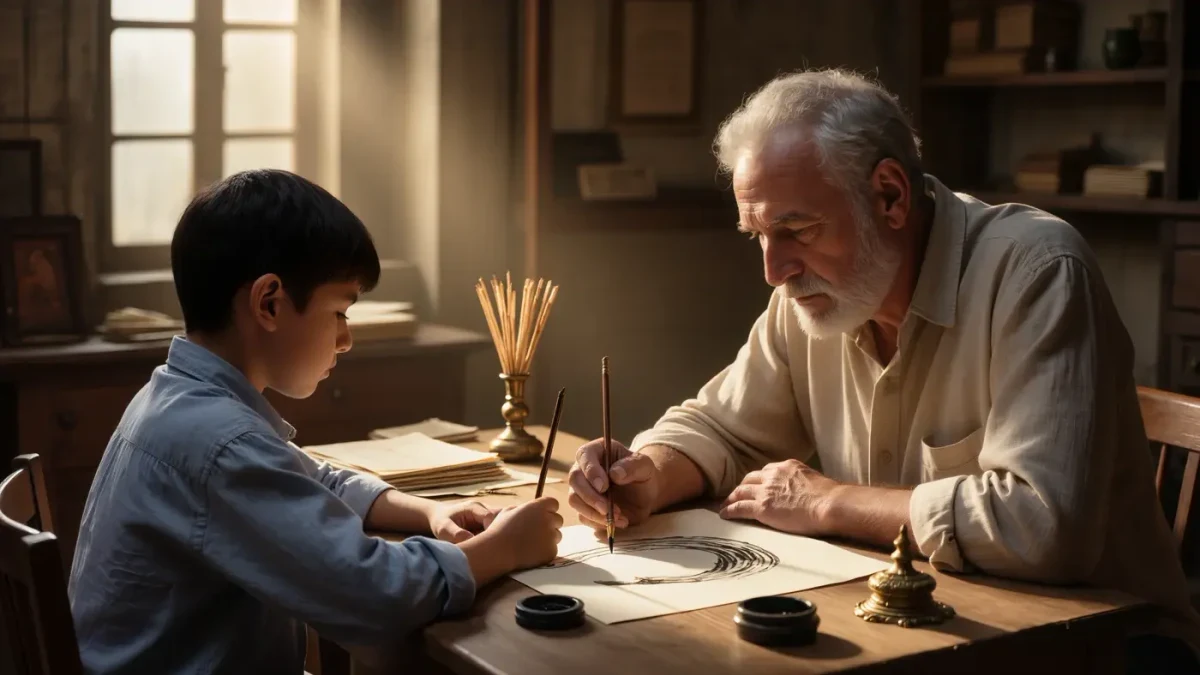
What museums show at rest, working calligraphers keep alive. Istanbul remains the tradition's most visible center: masters there still train students through years of copying, and still grant the icazet, the license that authorizes a calligrapher to sign independent work — a chain of transmission the art measures in teacher-student lineages, not diplomas. Contemporary practice ranges from that strict conservatism to artists who quote thuluth and nasta'liq in modern media. The tools have barely changed: the reed pen cut to a measured nib, soot-and-gall ink, and the patience proportion demands. It is one of the few medieval art systems that never lost its living school.
Frequently Asked Questions
Short answers to what readers most often ask: whether the restraint on images is a rule of the faith, which script matters most, whether the art can be learned, and why gold and blue dominate the old Quran pages. Each answer compresses the account above and stays within it.
Is figurative art forbidden in Islam?
Not by the Quran, which contains no such prohibition. Religious tradition and custom restricted figures in mosques and Quran codices, while courts and secular books used figuration freely. The restraint was contextual, and calligraphy rose to the top within it.
Which script is the most important?
Naskh, as the standard hand of Quran copies for centuries; thuluth as the monumental script of buildings; and nasta'liq as the favored hand of Persian and Urdu poetry. No single script “owns” the tradition — the system is the point.
Can calligraphy still be learned formally?
Yes. Courses exist in many countries, and in Istanbul the classical path survives: years of copying under a master, ending with the icazet, the license to sign one's own work.
Why so much gold and deep blue in old Quran pages?
Prestige and legibility together: gold leaf and indigo-dyed parchment were costly, marking the text's honor, and the contrast served reading by candlelight — the Blue Quran of the ninth or tenth century is the extreme case.