Start with the word itself. Merriam-Webster defines "why" as "for what cause, reason, or purpose," and traces it to an Old English instrumental form of "what" — the question aimed at purpose rather than manner, which is precisely the question a rehang answers (Merriam-Webster). A museum rehangs its permanent collection for cause: to rest fragile works, to reflect new scholarship, to tell a different story with the same objects.
The practical answer is simpler than most visitors expect. Museums rehang because the same works, seen in a different order, become different works. A painting moved from a chronological corridor into a room of its own stops being one step in a sequence and starts being an argument. What you notice on a return visit — a color you had missed, a pairing that suddenly makes sense — is not accident. It is design, and it is the point.
This is a companion piece to our earlier look at Why Museums Keep Sacred Art; here the question is not why the objects are held but why they are arranged — and rearranged — the way they are.
What does a museum rehang actually involve?
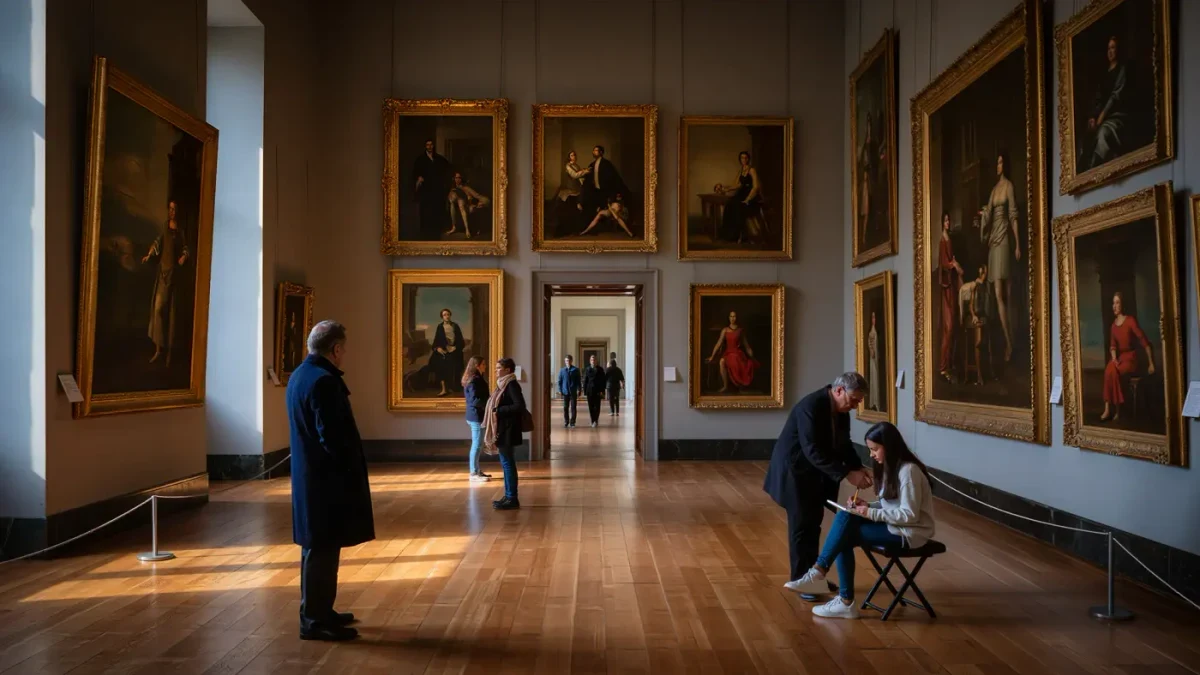
A rehang is a full or partial reinstallation of a permanent collection's galleries. The works are the museum's own; what changes is their placement, their neighbors, their lighting, and often the labels beside them. It is distinct from a special exhibition, which borrows works and runs for a fixed season. A rehang takes the collection you already know and quietly rebuilds the rooms around it.
In practice the work begins months before anyone lifts a frame. Curators draft schemes; conservators flag what can bear the move; registrars schedule the handling; educators test whether the new sequence reads to a first-time visitor. Walls are repainted, sometimes a deep pigment chosen to sit against a specific altarpiece. The visitor sees a refreshed room. The institution sees a year of decisions compressed into a morning of installation.
Why do sacred and light-sensitive works need rotation?
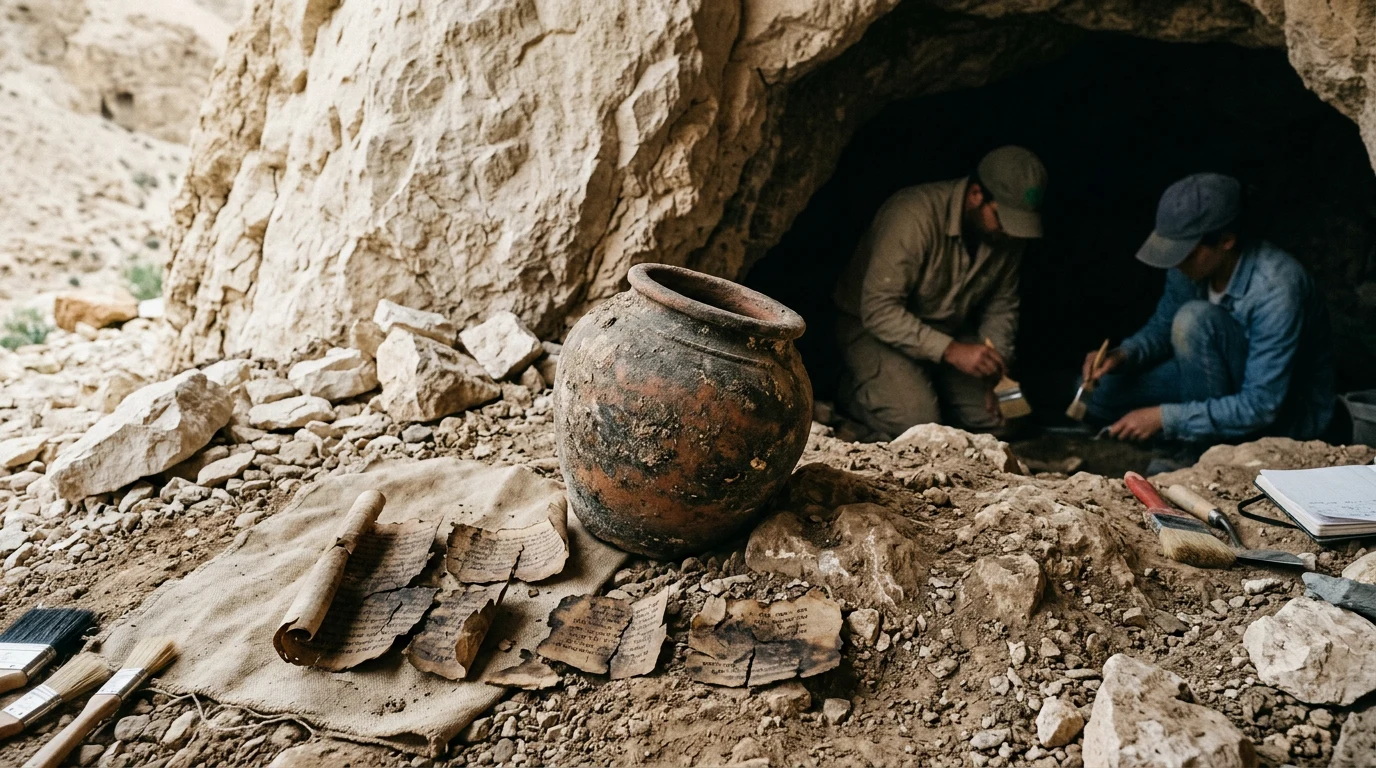
The least romantic reason is the most honest: many works cannot stay on view indefinitely. Works on paper — drawings, prints, manuscripts, illuminated leaves — are light-sensitive; the pigments and inks fade under sustained illumination, and the damage is cumulative and irreversible. Museums therefore rotate such works off display at intervals, giving each a rest in the dark of storage. Textiles, photographs, and many painted manuscripts fall under the same discipline.
For a reader of sacred texts as objects, this matters directly. A manuscript leaf or a devotional print may be visible for a stretch and then withdrawn, which is one reason a return visit can feel like a different museum. The rehang is often the visible face of a conservation schedule you never see. Our guide to How to Read a Stained Glass Window makes a related point about light: the medium is the display condition, and display conditions are decisions.
How does scholarship change a hang?
Attributions shift. Research revises what we believe about a workshop, a date, a patron. New acquisitions arrive and ask to be integrated. A work once filed under "school of" may be promoted; a pairing once thought natural may be dismantled. The rehang is where the collection absorbs the current state of knowledge — and where the museum's own reading of its objects is made public, in pencil annotations made visible.
Scholarship also revises the frame around the works. A generation of curators has rethought how religious art is presented: not as a neutral timeline of styles but as objects made for prayer, procession, and devotion. Our primer on How to Look at an Icon argues that an icon reads differently when you remember what it was made for. A rehang can build that memory into the room itself — lower light, closer walls, a bench placed where a kneeler once stood.
Chronological hang or thematic hang: which is better?
The two dominant schemes make different promises. A chronological hang says: here is how the art developed, one thing leading to the next. It rewards the visitor who wants history and context, and it flatters the collection that is strong across a long span. A thematic hang says: here are the questions the works answer — death, devotion, portraiture, the sacred and the domestic — regardless of when they were made. It rewards the visitor who wants arguments, and it can rescue a collection with gaps, because a thin decade matters less when the organizing principle is a theme.
Neither is correct; each is a bet on the reader. Our analysis: the chronological hang is the safer editorial choice and the less interesting one, in the way a well-made anthology is safer than a curated selection. The thematic hang risks incoherence but can produce the moments visitors actually remember — a medieval Crucifixion beside a modern print of the same scene, centuries apart, asking the same question. Museums rehang partly to place that bet differently after a run of years.
What should you notice on your next return visit?
Practical steps, offered in general terms. Walk the sequence in the order the rooms propose and ask what story the order tells. Read the wall text at the entrance of each room before the labels; the entrance text is the thesis, the labels are the evidence. Notice the wall colors — a curator's pigment choice against a specific work is a close reading made physical. Notice what has been withdrawn; absence on a light-sensitive work usually means rotation, not deaccession. And notice the pairings: two works hung together is the closest thing a museum has to a sentence.
For the biblical subject in particular, our guide to Where to See Rembrandt’s Biblical Paintings shows how one artist's sacred scenes read differently across collections — a reminder that hang and setting are part of the meaning. The same holds inside a single building. A rehang does not change the works. It changes the questions you bring to them, and then it changes the answers you find.
What this means for the reading life
There is a reason this subject belongs on a site about spiritual reading. A rehang is an act of interpretation without a new text — the oldest objects, a fresh arrangement, a revised argument. It is what a good edition of a translated classic does: same words, new paratext, changed emphasis. Our essays on Comparing Translations of the Tao Te Ching make the parallel explicit; the translation is a hang. The evidence here is qualitative, drawn from how museums describe their own practice rather than from any single dataset, and it establishes what rehanging is and why it happens. What remains unknown, for any specific museum and any specific visit, is the particular scheme in place when you arrive — which is the one fact worth checking before you go.