Postage stamp art is the most widely reproduced commissioning program in the world, and it may also be the least examined. Every year, postal services ask artists to compress a nation's memory into an inch of paper. The results travel in the billions, glued to envelopes, canceled by hand or machine, and then discarded. No museum, however ambitious, can promise that kind of circulation. The paradox is that the artwork everyone handles is the artwork nobody looks at.
The commissioning itself is quietly institutional. A postal service decides what deserves commemoration, briefs an artist or an in-house designer, and issues the result as functional currency for mail. According to USPS, customers can browse its collection of postage stamps by theme, color, season, and mail service — a merchandising sentence, but one that reveals how fully the stamp has become a curated object, chosen rather than merely bought.
What interests me, after two decades of watching commissions move through publishing houses, is the economics of the thing. A stamp commission pays modestly. It offers no openings, no reviews, no market. And yet it grants something the art world rarely does: genuine scale. A painter who works on a stamp reaches more eyes in a single mailing season than most gallery artists reach in a career. The trade is visibility without status, and it has shaped visual taste for over a century in ways that are hard to see precisely because they succeeded.
Consider what the format demands. A stamp is tiny, printed in flat inks on security paper, and must survive a perforating machine. It must read at arm's length and reward a second glance. Those constraints produce a recognizable style: simplified forms, strong silhouettes, dense symbolic packing. Generations of illustrators learned their economy there. The discipline of the small format — say the essential thing, omit the rest — is the same discipline that makes a good book cover or a good woodcut, and stamp work has fed those crafts rather than borrowed from them.
Commemorative stamps are public art with a delivery mechanism attached.
They are also, unavoidably, argument. Every issuance is a judgment about what a country wants to remember, and the judgments are never neutral. A stamp honoring a writer tells you the state has canonized him. A stamp honoring an overlooked figure tells you the canon is being revised. Because the postal service is a government organ, the whole program sits in that uneasy territory between patronage and propaganda — the same territory occupied by cathedral commissions and court portraits for most of art history. The difference is that the patron here changes with each administration, and the artworks are cheap enough to be contested in the press rather than in committee rooms.
The religious dimension is easy to miss and worth pausing on. Christmas stamps, Eid stamps, Hanukkah and Kwanzaa issues — these are among the most widely distributed sacred images on earth. A nativity on a stamp reaches households that no church publication will. It is devotional art in the oldest sense: an image made for repetition, handled daily, worn smooth by use. The comparison to the icon is not decorative. Both traditions accept that a holy image's power lies partly in its ubiquity, in being present at the small transactions of ordinary life. Readers of our piece on how to look at an icon will recognize the logic, though the stamp's theology is civic rather than liturgical.
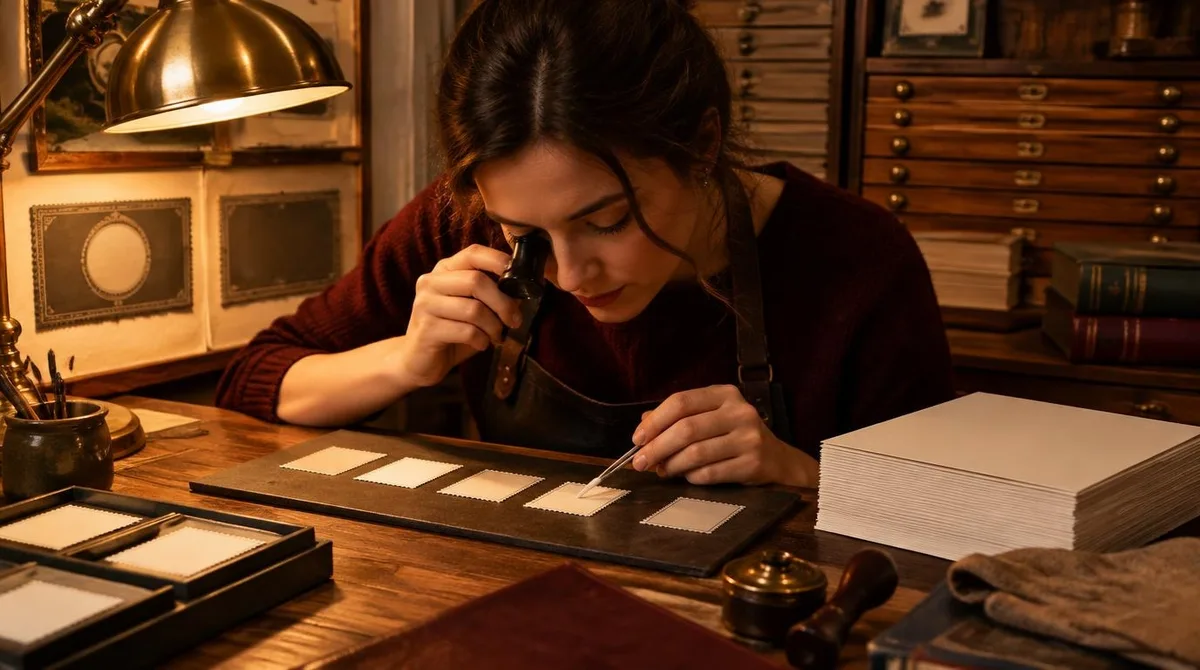
There is also a collecting economy layered over all of this, and it behaves nothing like the art market. Stamp collectors — philatelists, in the term of art — value condition, postmarks, printing errors, and first-day covers. An error can be worth more than a perfect sheet. This inverts the usual rules, where the flawless object commands the premium, and it gives the field a scholarship all its own: people who can date a stamp by its perforation gauge the way I can date a book by its typography. The market is small next to the auction rooms we cover elsewhere, but it is real, and it keeps a documentary archive of every design decision a postal service has made.
Our analysis: the stamp's real cultural work is not commemoration but normalization. It teaches the eye. Flat color, bold lettering, a figure isolated against a plain ground — the visual grammar of the stamp anticipated much of modern graphic design, and postal programs were running that grammar at mass scale while the design schools were still formulating it. The patron was accidental. Nobody at a postal administration set out to train a century's visual taste. But commissioning is commissioning, and money spent on images at scale has effects regardless of intent. The same dynamic appears in other unlikely patrons; the story of how Notre-Dame commissioned its new stained glass shows a cathedral administration making contemporary-art decisions with centuries of consequence, and the postal service makes a faster, cheaper, far more disposable version of those same decisions every year.
For the reader who wants to look rather than collect, the practical steps are simple. Start with the commemorative issues of your own country; the USPS stamp store lets you browse by theme, which turns browsing into a kind of impromptu survey show. Look for the designer's name — it is printed on the stamp, usually in tiny type along an edge, and tracking a single designer across issues teaches more about the craft than any overview. Notice what gets chosen and what never does. The absences are arguments too. And if the small format hooks you, the collecting instinct it awakens is the same one our guide to starting a modest art collection addresses: buy what you can afford, learn the field before the objects, and let the archive teach you patience.
The stamp will not survive email. Volumes fall, programs shrink, and the day is coming when commemorative issues exist mostly for collectors, the way illuminated manuscripts outlived the scriptorium. That is not a tragedy so long as the commissioning survives, because the commissioning is the art. A small paper rectangle, designed by a working artist, printed in the millions, licked and stuck and sent — it is public art with a delivery mechanism attached. The gallery world could learn something from a patron that asks for one image, pays little, and guarantees the whole country will see it.