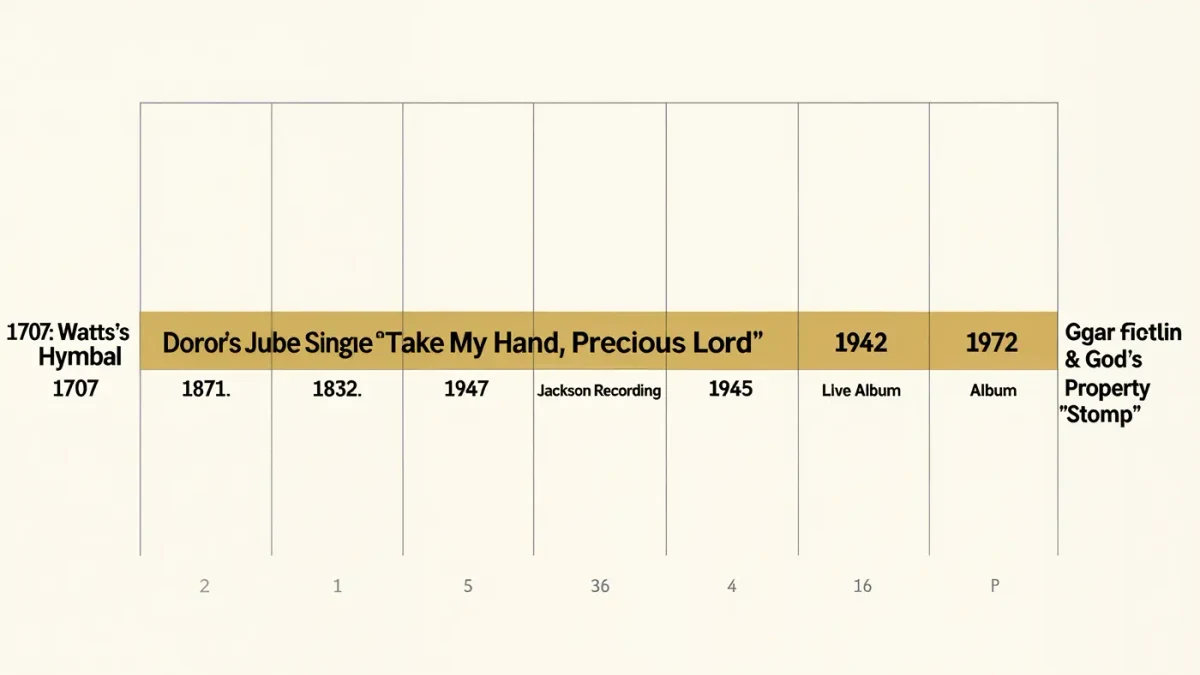
The history of gospel music runs from Isaac Watts's Hymns and Spiritual Songs (1707) through the spirituals of enslavement to a named, copyrighted, urban genre assembled in Chicago around Thomas A. Dorsey in the 1930s. Its golden age, roughly 1945 to 1965, belongs to Mahalia Jackson, Sister Rosetta Tharpe and a generation of touring quartets.
Where Does the Line Begin?
With a quarrel about who may write a hymn. Isaac Watts (1674–1748) argued that congregations should sing composed songs, not only rhymed psalms; his collections — “When I Survey the Wondrous Cross” among them — carried hymnody into every English-singing tradition. In Black congregations, Watts met an older practice: lined-out singing, a leader calling each line and the congregation answering.
In lined-out singing the line is stretched and ornamented as it goes. Out of enslavement came the spirituals — “Go Down Moses,” “Steal Away” — songs whose meanings were devotional on the surface and, in the reading of many historians, doubled as signals and sustenance under conditions no music had been asked to survive before. In 1871, at Fisk University in Nashville, a student group organized as the Fisk Jubilee Singers began performing concert arrangements of the spirituals; their tours, which reached Britain and Europe in the 1870s and included singing before Queen Victoria, turned the repertoire into an international sensation and funded their school. Gospel, when it arrived, inherited both streams: the composed hymn and the sung inheritance.
What Was Thomas A. Dorsey's Invention?
A fusion and a business. Dorsey (1899–1993) had spent the 1920s playing blues piano in Chicago and recording risqué sellers as “Georgia Tom” alongside Tampa Red. He carried that harmony, that rhythm and that polish back into the church, and the result — religious words on blues foundations — is what came to be called the gospel song.
The turning point of the Georgia-born pianist's life fixed the genre's signature song. In August 1932, Dorsey's wife Nettie died shortly after childbirth, and their son died days later; out of that grief he wrote “Take My Hand, Precious Lord,” which became the most widely sung gospel song of the century. With the singer and organizer Sallie Martin, he ran publishing operations, conventions and workshops from his base at Chicago's Pilgrim Baptist Church — building not just a sound but an industry, with songwriters, printers, teachers and touring soloists. The “Chicago sound” this machinery produced — piano, Hammond organ, solo voice over choir — became the genre's default setting.
What Happened in the Golden Age, 1945–1965?
The music professionalized, broadcast itself and crossed over repeatedly. Mahalia Jackson (1911–1972) became the genre's defining voice with “Move On Up a Little Higher” in 1947, written by the Reverend W. Herbert Brewster; Sister Rosetta Tharpe (1915–1973) had already taken gospel onto the pop charts with an electric guitar. The quartets did the touring.
Born in New Orleans and formed in Chicago's South Side churches, Jackson reportedly sold millions of copies of that record, and sang at the March on Washington on 28 August 1963, immediately before Martin Luther King Jr.'s “I Have a Dream” speech. Tharpe's “Strange Things Happening Every Day,” recorded in 1944 with the Sammy Price trio, reached number two on Billboard's race records chart, its distorted guitar a blueprint for the rock and roll that followed; her importance was formally acknowledged when the Rock and Roll Hall of Fame inducted her in 2018.
The same years belonged to the quartets: the Soul Stirrers, whose long-time lead R. H. Harris shaped modern gospel singing before Sam Cooke joined the group in 1950 and left for pop in 1957; the Dixie Hummingbirds, later featured on Paul Simon's “Loves Me Like a Rock” (1973); the Five Blind Boys of Mississippi and of Alabama; Clara Ward and her Singers, whose “Surely God Is Able” became a standard. Hard touring, radio and recording contracts bound Black congregations into a single national market, and the market leaked in every direction.
What Came After?
Crossover became the condition, not the exception. Aretha Franklin's Amazing Grace (1972), recorded with the choir of the Reverend James Cleveland in a Los Angeles church, became one of the best-selling gospel records ever made; the concert film of those services was released in 2018. Andraé Crouch updated the palette in the 1970s, and Kirk Franklin took gospel into hip-hop.
Kirk Franklin's “Stomp” (1997) set gospel choirs inside hip-hop production and topped R&B radio, and the genealogy is audible across American music: without the golden age there is no soul catalogue, and a good deal of what is called soul was gospel with the words adjusted.
What holds the tradition together through all of this is not a style — the styles have changed repeatedly — but the habit of the music: voices trained in church, repertoires built for participation, and songs written to be sung by a room rather than merely at one. That habit survived every crossing.
Frequently Asked Questions
Common questions, briefly answered: the difference between spirituals and gospel, the origin of the name, the first stars, and where to hear the classic recordings today. Each answer condenses the account above and adds nothing that cannot be sourced from it.
Are spirituals and gospel the same thing?
No. Spirituals are the older, largely anonymous repertoire formed under enslavement; gospel songs are composed, copyrighted, urban twentieth-century works. Gospel grew from the spirituals and from hymnody, and the two repertoires are often performed side by side.
Why is it called gospel music?
From the gospel song — “good news” — the name used for Dorsey's repertoire and the market built around it in Chicago in the 1930s. The term attached to the genre, then to the industry, then to the whole tradition retrospectively.
Who was the first gospel star?
Sister Rosetta Tharpe was recording hits in the 1940s, but Mahalia Jackson, after “Move On Up a Little Higher” in 1947, became the genre's first mass-culture celebrity — its most famous voice for a quarter of a century.
Where can I hear the golden age today?
Reissue labels have kept the catalogues of the 1945–1965 era in print and streaming, and Aretha Franklin's Amazing Grace (1972) is the single most accessible document of the sound — the 2018 concert film of those recordings shows the tradition in its natural setting.