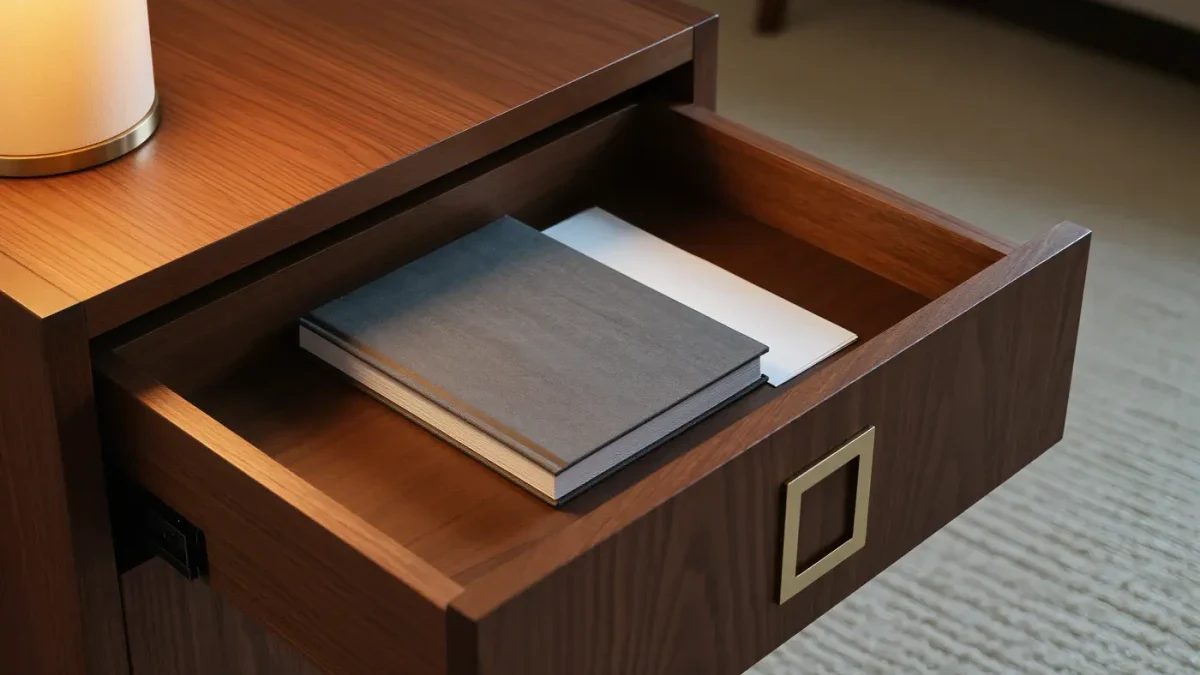
One of the most widely distributed books in America is not sold; it is left, quietly, in the drawer of a bedside table. The Gideons International — founded in 1899 by traveling salesmen in Boscobel, Wisconsin — began placing Bibles in hotel rooms in 1908, and the drawer has never quite been empty since.
The founding scene is a commercial travelers’ story. In September 1898, two salesmen, John H. Nicholson and Samuel E. Hill, strangers to each other, ended up sharing a room at a crowded hotel in Boscobel, Wisconsin; the conversation turned to faith, and they spent part of the evening in prayer. Meeting again by chance the following year, with Will J. Knights, they organized an association of Christian commercial travelers and took their name from the Book of Judges — Gideon, the farmer who led three hundred men against an army with torches and trumpets. The mild irony of insurance men and hardware drummers naming themselves after a commander of irregulars seems not to have troubled anyone. Salesmen, after all, also go where they are not expected and speak to strangers.
The association’s first work was modest: witness among men on the road, tracts, personal example. The economics of what followed are peculiarly clean. The books are paid for by members’ contributions, placed by volunteers, and replaced by hotels when guests carry them off — no sales force, no returns, no pulpit, no inventory risk. It may be the most efficient distribution system in the history of printing, and it runs on a channel every other publisher ignored: the drawer of a nightstand in a town the traveler will never see again.
The Gideon Bible became, by accretion, a fixture of twentieth-century American fiction and film — the book a detective leafs through for a cipher, the prop on the nightstand that establishes a room as American. Few objects say roadside country so economically. The drawer is a set piece now; set pieces outlast the reasons they were built.
The idea that made the association famous came a decade later, in 1908: scripture in hotel rooms. The logic was occupational. Men who lived in hotels knew exactly what a hotel room was — a clean, well-lit place to be alone in a strange city — and the association resolved to put a Bible within arm’s reach of the bed. The membership grew into an international corps of Christian business and professional men, with an Auxiliary of their wives; the placements grew from hotels into hospitals and prisons, and for decades to public schools, until litigation and changing norms pushed the classroom distribution mostly out.
The scale, by the organization’s own accounting, is beyond any publisher’s dream: more than two billion Bibles and New Testaments distributed since 1908, across roughly two hundred countries and territories. The hotel-room copy is typically a full Bible or a New Testament bound with Psalms and Proverbs, its flyleaf explaining that it is placed as a gift by the Gideons. No bestseller list has ever counted a single unit. Nothing that is given away gets counted twice.
Why the drawer, though? The nightstand is the least contested furniture in the room. The desk belongs to work, the television to the room’s official entertainment; the drawer — shared with hotel stationery and, once, the phone directory — holds what the room offers without asking. A book in that drawer is not displayed, not pushed, not for sale. It is simply available, at the height of a lying-down hand, to the sleepless, the stranded, the newly alone, and the newly married; to the man at three in the morning with bad news in his phone; to the woman between flights with nothing in her bag. Scripture encountered there arrives without congregation, without commentary, without context, and without anyone watching — conditions under which, historically, very little scripture has ever been read.
There is a quarrel embedded in the drawer, and honesty requires naming it. For the Gideons, the placement is hospitality: the room has a bed, a lamp, and something for the dark hours. For travelers of other faiths, or of none, the book’s presence is an argument folded into the furniture — a presumption about what a stranger needs. Both readings are accurate; the drawer holds them together the way a hotel holds everyone, briefly and without preference. And the book can be taken. The Gideons do not count a taken Bible as theft; the Bibles are gifts, hotels reorder, and a copy leaving in a suitcase is, in the association’s own terms, a delivery.
What the drawer preserves is the chance encounter with a text — a form of reading that curated feeds, algorithmic shelves, and searchable everything have nearly abolished. Nobody chose it for you; nobody recommended it; it was simply there when you opened the drawer for the stationery. Reading that begins by accident has a different temperature. The book was not seeking the reader; the reader was not seeking the book; a nightstand happened.
And the numbers keep their own kind of silence. If the Gideons’ arithmetic is right — more than two billion copies since 1908 — then there is one for roughly every four people alive. Two billion is a number the human ear cannot hold; one book per four people is arithmetic it can. No one counts the nights the drawer is opened. Nothing else printed comes close, and nothing else printed is so easy to forget.