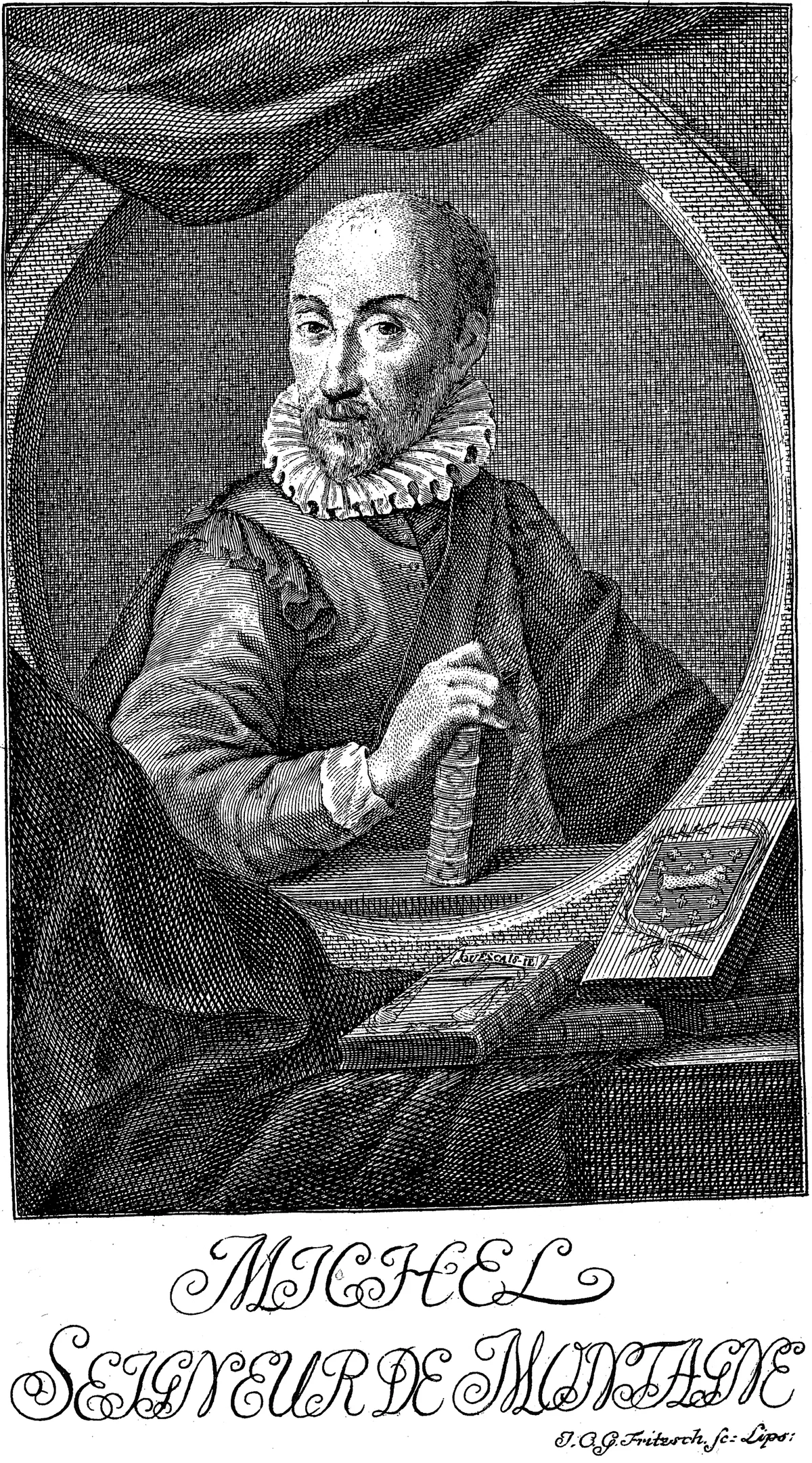
Start the Essays of Michel de Montaigne anywhere, and start small. He wrote short, wandering pieces with plain titles — "Of Idleness," "Of Liars" — and he never expected anyone to read them in order. The book was published in 1580, enlarged in 1588, and reissued after his death in 1595, and he kept adding to it for the rest of his life. That means there is no correct entry point. There is only the chapter you open first.
That looseness is the good news for a beginner. Montaigne (1533–1592) was a retired French nobleman writing in a tower library on his family estate, trying to think his way out of melancholy. According to the Stanford Encyclopedia of Philosophy, he began committing his thoughts to paper "to escape fits of melancholy," and the habit became a life's work. He is the reason the word "essay" means what it means: an attempt, a weighing, not a verdict.
This guide walks through what the book is, how its strange publication history affects what you buy, and which chapters reward a first pass. If you are new to essays as a form, it may help to know that nearly every personal essayist since is, in some sense, replying to this man.
Who was Montaigne, and why does he matter?
He was, by birth, a striver's son. His father made money in trade, bought his way into the minor nobility, and came home from fighting in Italy determined to import refined culture to France. One experiment tells you the household's temperament: the father decided his son would not learn Latin in school, so a German tutor and the whole family spoke Latin to him at home. The boy grew up reading Vergil, Ovid, and Horace on his own, before he could comfortably speak the language of his own country.
The adult life was conventional until it wasn't. His father bought him a place in the courts; his closest friend, Étienne de La Boëtie, died in 1563 and left him, by his own account, undone. At 37 he retired to the castle, had wisdom formulas carved into the wooden beams of his library — lines from Ecclesiastes, Lucretius, Sextus Empiricus — and started writing. He would later be pulled back into public life twice, serving as mayor of Bordeaux, but the tower was the real address.
Why he matters: the Essays put a single, ordinary, doubting mind on the page and refused to tidy it up. He questioned the assumption that humans rank above animals, that European civilization ranks above so-called barbarians, that reason is the universal standard it claims to be. Those are not small moves, and he made them in prose that sounds like a man thinking out loud, because it is.
Which edition should a beginner read?
Here is the part that scares newcomers, so let's defuse it. Montaigne never stopped revising. Scholars label his layers A, B, and C, for the 1580, 1588, and posthumous 1595 editions, and modern translations usually show all three, so you can watch a sentence grow over twelve years. The 1595 edition was prepared by his adoptive daughter Marie de Gournay, working from his manuscripts — he did not live to supervise it. Later scholars set that text aside in favor of the "Bordeaux copy," the 1588 edition annotated in his own hand.
What this means for you, practically: do not agonize. Any complete modern translation will carry the layered text and mark the additions. The layers are a bonus for a second reading, when watching him re-think himself becomes the pleasure. On a first pass, the differences between 1580 and 1595 are footnotes, not obstacles.
Where should you actually start reading?
Not at the beginning, and not with the longest chapters. A workable first pass:
- "Of Idleness" (I, 8). Short, and it is the origin story: a restless mind given leisure and told to settle, which refuses. The whole project starts here.
- "Of Liars" (I, 9). A short companion piece. Read them back to back and you see his method — jump, digress, return.
- "Of Prompt or Slow Speech" (I, 10). Montaigne on his own tongue-tiedness. It is disarming to meet a great writer confessing he thinks slowly.
- "Of Prognostications" (I, 11). Skepticism applied to fortune-tellers, delivered with more curiosity than scorn.
Notice the sequence: chapters eight through eleven, consecutive, all short. The Stanford Encyclopedia notes that Montaigne himself acknowledged the random aspect of the work — he leaps from idleness to liars to speech to prophecies with no visible connective tissue. Reading a short run of consecutive chapters lets you feel that jumpiness instead of fighting it. After that, wander. The book forgives it; it was built for it.
How do you read him without getting lost?
Three habits help. First, read in short sittings. These chapters were written by a man pacing a tower; they reward the same rhythm. Second, don't chase every classical reference. He quotes Lucretius and the Stoics constantly — one scholar's count cited by the Encyclopedia puts it at one verse in sixteen of Lucretius' De natura rerum appearing somewhere in the Essays — but you can let the quotations wash past and still follow the argument. Third, treat the book as a companion, not a course. He is not building a system. He is keeping himself company, and inviting you to sit in.
Our analysis, for what it is worth: the beginners who bounce off Montaigne are usually the ones trying to read him linearly, like a treatise. The ones who stay treat him like a diary found in a drawer — dip, skip, reread. He edited himself for decades, adding rather than correcting, which means the book has no finished state to reach. There is no finish line to miss.
If his habit of endless self-revision sounds familiar, you may enjoy our piece on How to Edit Your Own Essays Without Cringing. And if you like the idea that a book's margins and layers carry their own story, Other People's Margins takes up that theme. Readers drawn to the contemplative side of all this might also like our guide to What We Mean by Spiritual Reading — Montaigne's tower, with its carved scriptural beams, sits closer to that tradition than his reputation as a worldly skeptic suggests.
What the Essays leave open
The evidence establishes a few things clearly: a rich man's son turned skeptic, a book assembled across three editions by a writer who preferred adding to correcting, a text so open-ended that scholars still argue about its unity. What remains unknown is the thing Montaigne himself kept circling — whether all that self-examination ever settled anything. He would probably say that was the wrong question. The attempt was the point. Pick a short chapter, read it slowly, and let the attempt be yours too.