In May 1373, a woman in Norwich, thirty and a half years old by her own count, believed she was dying; instead she was shown sixteen things, and spent the rest of her life writing them down. Revelations of Divine Love (1373) is the earliest surviving book in English known to have been written by a woman.
She tells the scene herself, and the telling is the book’s authority. For days she had been ill; a curate was sent for, and he set a crucifix before her eyes and administered the last rites. In the hours before dawn the showings began — sixteen of them, fifteen while she lay at the edge of death and one more the following night, after the pain had lifted. Nothing in the account is passive. She had asked for this, years earlier, in three petitions: the wound of contrition, the wound of compassion, the wound of longing for God; and beside them two bodily requests — a sickness at just this age, and a sight of Christ’s passion. A woman petitioning God for pain: the vocabulary unsettles readers in every century, including the centuries that read her without ever learning her name.
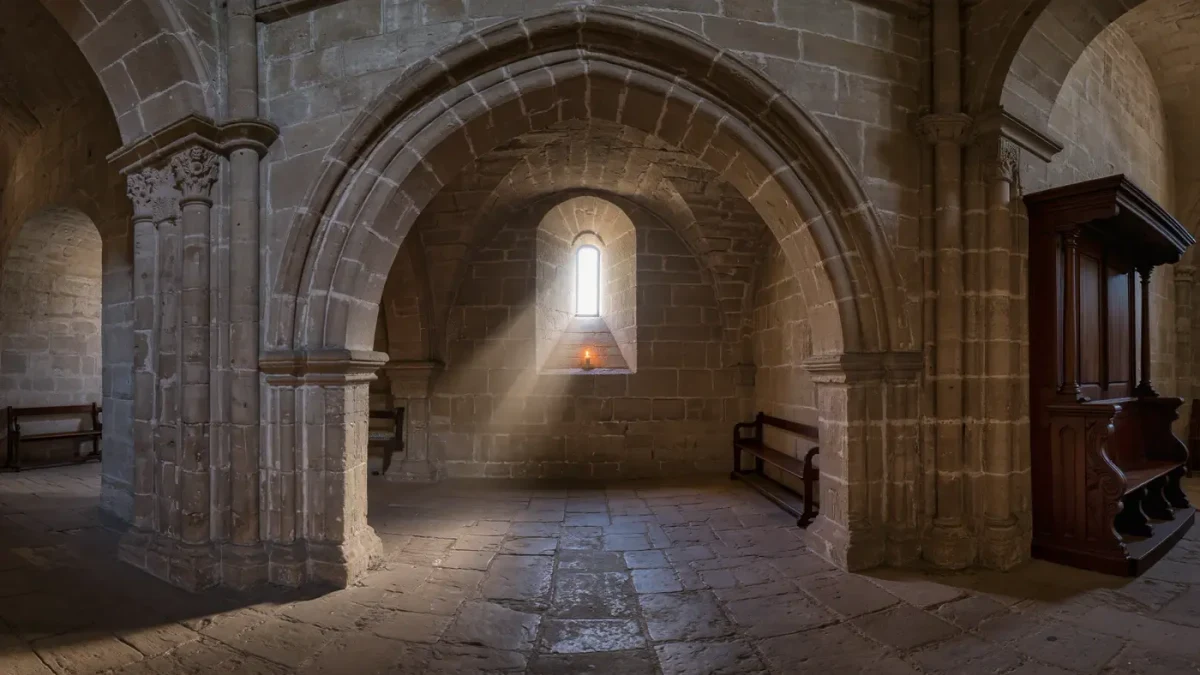
“Julian” is the church’s name, not hers. She lived as an anchoress attached to the church of St Julian in Norwich — a cell built against the wall of a parish church, an enclosure entered once and not left. Her baptismal name is recorded nowhere. What survives in its place is the work, in two versions: a Short Text written soon after the showings, and a Long Text, expanded over some twenty years of reflection, in which the sixteen visions grow chapters, questions, and second thoughts.
The most famous of the showings is the smallest. In the palm of her hand she sees a little object, “the quantity of a hazelnut,” and asks what it is. She is told: it is everything that was made. It lasts, and always will, because God loves it. The image has traveled for six centuries precisely because it is measurable — creation the size of something you could close a fist around, and held, not dropped.
Harder travel has fallen to the book’s other famous sentence, which arrives not as a greeting but as an answer wrung out of the problem of sin. “Sin is behovely,” she writes — necessary, useful, a word that has never settled comfortably into modern English — and only after holding that difficulty does the line come:
All shall be well, and all shall be well, and all manner of thing shall be well.
Note the tense. Not all is well; not all seems well. The promise is aimed at a future she does not pretend to see, which is why it reads as hope rather than reassurance. She is careful, even forensic, about what was shown to her and what was not: the question about sin was answered “in this manner,” she says, and she declines to tidy the remainder.
The Long Text also contains her most radical teaching: the motherhood of God. Christ, she writes, “is our Mother” — feeding, forming, laboring — with the tenderness of the word carried through whole chapters. Medieval theology had images for authority in abundance; Julian supplied one for the nursery, and grounded it not in sentiment but in the physicality of gestation and nursing. Her favorite word for God’s manner is “courtesy”; her sense of divine love is “homely,” in the Middle English sense of familiar, domestic, near.
Norwich in her lifetime was a port city that had been gutted by plague. The Black Death reached it in 1349, when she was a child, and the epidemics kept returning through her adult years; she lived in a city of empty plots and hasty rebuilding, and scholars have long read her emphasis on a love that holds all things the size of a hazelnut against that background of mass burial. The book never mentions the plague directly. It does not have to.
Visitors came to the anchorage. The Book of Margery Kempe, dictated by the Lynn townswoman whose own visionary life scandalized her neighbors, records a visit to the anchoress for counsel — the closest thing Julian has to a scene in another writer’s work. The last documentary trace is a will of 1416, in which a Norwich citizen leaves the anchoress a bequest. After that, the cell and the name go quiet; the book goes underground.
Underground, in her case, means exile. The Long Text survives chiefly in manuscript copies made in the seventeenth century by English Benedictine nuns living abroad, who kept her prose alive after the English manuscript tradition had gone cold; the first printed edition, edited by the Benedictine Serenus Cressy, appeared in 1670. The modern recovery rests on the critical edition of Edmund Colledge and James Walsh, A Book of Showings (1978), which set the Short and Long Texts side by side and made her, for the first time, fully quotable.
Her sentence survived her anonymity, the manuscript exhumation, and the Second World War. St Julian’s church was destroyed in the German bombing of Norwich in 1942; it was rebuilt and reconsecrated in 1953, and the site of the anchorhold is marked on the modern building. Pilgrims still come to a cell that encloses no one.
The church is stone; the cell is an outline; the name on the guidebook belongs to a saint of legend with whom she shared nothing but an address. What is actually hers is the prose, the hazelnut, the tense of the promise. Nobody knows what she was called. Everyone who has read her knows how she prayed.