Kathleen Norris went to the monastery for the poetry and stayed for the morning psalms. The Cloister Walk (1996) is her account of life as a Protestant poet and Benedictine oblate — a lay associate of a monastery — and of what happens to a writer’s ear when the same ancient poems are read aloud every day, in community.
The background is Dakota. Norris grew up between Washington, D.C., and the small South Dakota town where her grandparents lived; in 1974 she and her husband, the poet David Dwyer, moved to Lemmon, into her grandparents’ house, and stayed. The move produced Dakota: A Spiritual Geography (1993), a book about emptiness — of the plains, of a congregation, of her own religious education — that ends, against expectation, with her back in church. Not converted: returned. The distinction matters to everything she has written since.
The monastic turn came next. Drawn first to Assumption Abbey, the Benedictine monastery at Richardton, North Dakota, and then to extended stays among the monks of St. John’s Abbey in Collegeville, Minnesota, she eventually made her promise as an oblate — a lay person formally affiliated to a monastery, who keeps the Benedictine spirit inside an ordinary life, keeps her own church, and comes and goes. The Cloister Walk is the record of those stays: not a conversion story, since she remained Protestant, and not a retreat memoir, since she kept going home, but something rarer — a report from inside a liturgy by someone with a poet’s training and no obligation to defend it.
What she found, and what the book keeps circling, is the Divine Office: psalms and readings at fixed hours, the day punctuated rather than filled, the monks’ own name for it the opus Dei — the work of God. Within living memory this office was sung in Latin; in its English it keeps the same skeleton, the same hours, the same rotation of a hundred and fifty psalms. Norris’s first discovery is formal: the office is a poem performed on a schedule. Its form is repetition; its subject is everything a human being can feel in a week, including the feelings congregations are not supposed to have.
The office lives inside a text older than any of its singers: the Rule of St. Benedict, the sixth-century constitution of Western monasticism, which opens by asking the reader to incline the ear of the heart. Norris treats that phrase as a poetics, and she is right to. The hours themselves — Vigils in the dark, Lauds at first light, the day’s shorter offices, Vespers toward evening, Compline last — are less a timetable than a meter: a poem the day scans.
Her other great subject is acedia, the “noonday demon” the desert monks named: not sadness, which has an object, but the flat refusal of care — the disinclination to go on with what one is. Writers know it at desks; monks know it at noon. Norris’s argument, drawn from the monastic psychologists and tested against her own Dakota winters, is that the hours are engineered against it. Something in you does not want to show up. The bell goes anyway, and the psalm is said by the room until you are ready to be said by it.
That is her second discovery, and the book’s best chapter is about it. The psalter refuses niceness. There is a psalm that blesses the smashing of enemies’ children against rocks; there are psalms of revenge, of terror, of self-pity so frank it would clear a workshop. Monks say them anyway, at fixed hours, for decades — the section Norris titles “The Paradox of the Psalms” carries her answer: the psalms do not ask to be meant on any given morning. They ask to be said. The meaning arrives or doesn’t, at its own speed, over years; the liturgy accommodates the honest, which is more than most conversations manage.
A poet, of all readers, would notice this first. The Office trains exactly the muscle poetry trains: the willingness to keep words in the mouth past the point where sincerity has been established, on the gamble that the mouth knows something the mood doesn’t. Norris’s prose has the trained quality — her chapters are themselves like hours, short, recurrent, ending without conclusions — and her claim, made casually and repeatedly, is that liturgy and poetry are neighboring arts. Both are forms that wait. Both assume you will come back tomorrow and say it again, differently.
She is also a frank guest. The book records her quarrels with the tradition she is borrowing: its language about women, its hierarchies, the inherited sentences that a congregation repeats without hearing. None of it resolves. The monasteries she describes tolerate her doubt in a way her original churches didn’t quite; there is something in the office’s indifference to her mood that she experiences, over years, as mercy. Doubt, given a schedule, becomes survivable.
When Riverhead published the book in 1996, it became an unlikely bestseller — psalms and office-houses on the same lists as thrillers, which is its own kind of parable. The readers who found it were mostly not headed for monasteries. They wanted what the book models: a way of reading that is slow because the text is bigger than the reader, and repeated because one pass at anything true is a form of skipping.
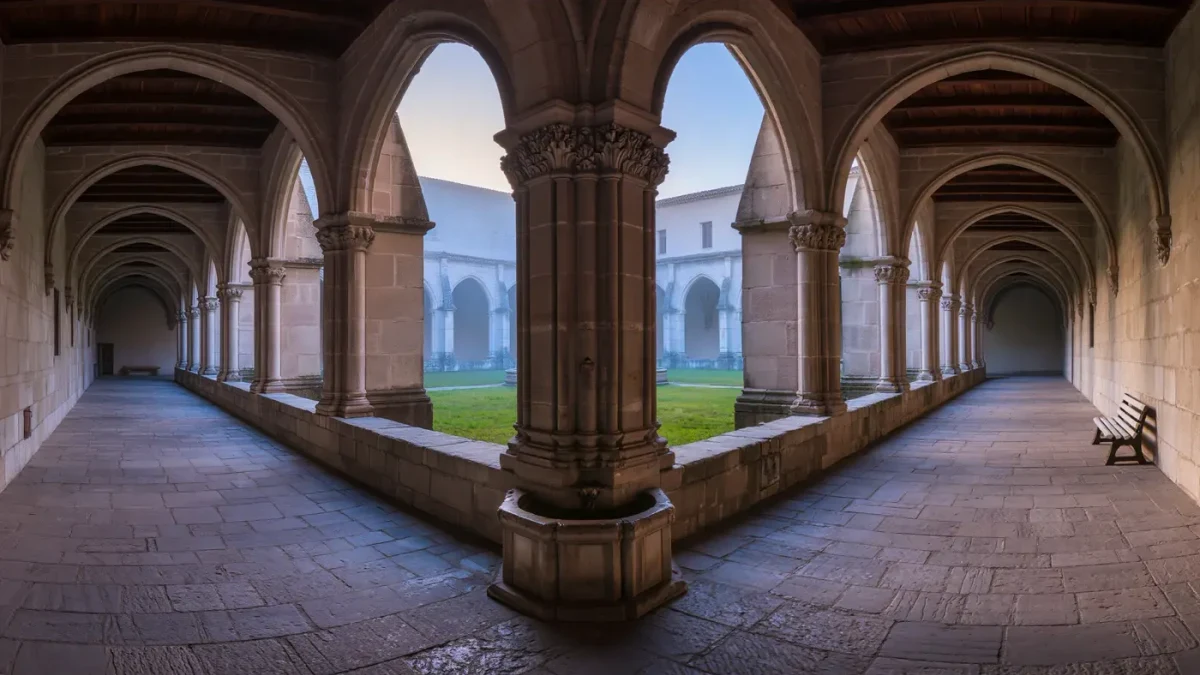
A cloister walk, in architecture, is a covered arcade around a courtyard — a path whose whole business is return: to the church, to the refectory, back to the church. Norris borrowed the term for her title and built the book on its plan. The psalter does not conclude; it circles. At St. John’s, the first office of the day still begins in the dark.