The King James Bible, printed in 1611, fixed a stock of English phrases — “the powers that be,” “a thorn in the flesh” — in common circulation and set a cadence that writers from Melville to Morrison absorbed and answered. It shaped English less by inventing than by circulating: one book, heard aloud everywhere, for three centuries.
Why Was a New Translation Made in 1611?
The project was agreed at the Hampton Court Conference of January 1604, where the new king, James I, adopted a Puritan petition for a fresh rendering of Scripture as his own. Some forty-seven scholars, in six companies at Westminster, Oxford and Cambridge, worked through the Hebrew and Greek; the book appeared in 1611 from the king's printer, Robert Barker.
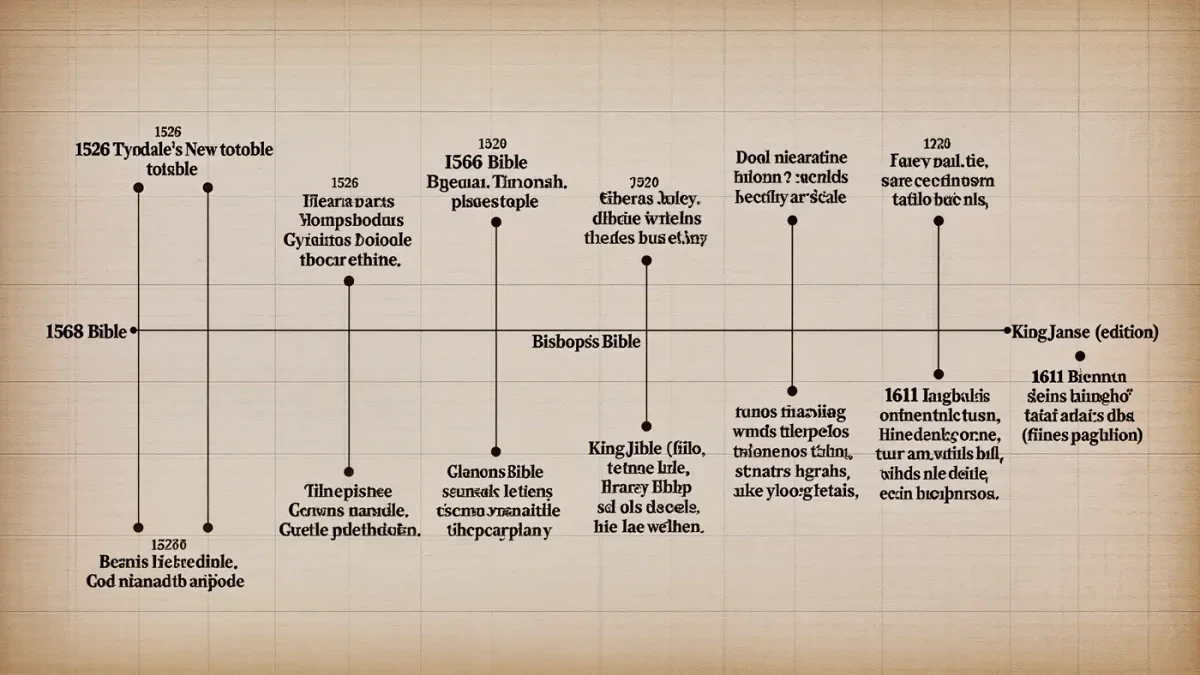
The rules that survive from the project tell a restrained story. The translators were to follow the Bishops' Bible of 1568 where it could be defended, to consult older versions, and to add no interpretive marginalia beyond brief notes on Hebrew and Greek words. James wanted one text for a divided church — a book that Puritan scholars and conformist bishops could equally be bound to. Nobody involved described the result as a literary monument. It was meant to be read aloud from pulpits, in a language tuned for the ear, and its prestige came later, through use.
Which Everyday Phrases Come From the Translation?
Dozens survive in speech. “The powers that be” rests on Romans 13:1; “a thorn in the flesh” on 2 Corinthians 12:7; “a lamb to the slaughter” on Isaiah 53:7; “fight the good fight” on 2 Timothy 4:7; “a house divided” on Mark 3:25; “at his wit's end” on Psalm 107:27; “escaped with the skin of my teeth” on Job 19:20.
“The love of money is the root of all evil” (1 Timothy 6:10) belongs on the same list, and so does the phrase behind Abraham Lincoln's 1858 speech accepting the Illinois senate nomination: the wording is close enough to Mark 3:25 that audiences heard the Bible underneath the politics. The same layer sits beneath “the straight and narrow” (behind Matthew 7:14, where “strait” means narrow, not honest), beneath “give up the ghost,” beneath “the sign of the times.” Because the book was read in course, Sunday after Sunday, its locutions became the shared furniture of English solemnity — available to believers and skeptics alike.
How Much Does It Owe to William Tyndale?
Nearly everything, which is the story's honest complication. William Tyndale, who printed his English New Testament at Worms in 1526 and was strangled and burned near Brussels in 1536, supplied so much of the wording that by scholarly estimate four-fifths of the 1611 New Testament keeps his phrasing. The later translators worked as revisers of a century of English Bibles.
“The powers that be” is already Tyndale's, sitting in his 1526 rendering of Romans. The Geneva Bible of 1560 — the household Bible of Shakespeare's generation, carried to New England — and the Bishops' Bible of 1568 passed the inheritance along, and the 1611 companies condensed it. This does not diminish the achievement; it describes it. A committee of scholars, holding the best Greek and Hebrew scholarship of northern Europe, chose in case after case not to improve on a condemned reformer's rhythm, because his rhythm was better. The King James Bible is a monument to editorial restraint.
How Did It Enter Literature?
Through the ear before the eye. For three hundred years it was the one text most English speakers were guaranteed to hear aloud, so its periods became the default register of high seriousness — imitated even by writers who wanted nothing from its theology. Herman Melville's Moby-Dick (1851) is drenched in it, from the sermon on Jonah to Ahab's blasphemies.
Ahab's blasphemies borrow the very diction they attack. William Faulkner took the title of Absalom, Absalom! (1936) from David's cry over his son; John Steinbeck's East of Eden (1952) rests on Genesis 4; Toni Morrison's Song of Solomon (1977) takes both title and cadence from the book that carries her characters' names. The influence is not always devotional. It is often adversarial, an argument conducted in the opponent's language. When modern translations replaced the 1611 text in most churches over the twentieth century, the older wording did not leave; it simply stopped being scripture and became literature, freely quotable, no longer tied to any pulpit. The story of how the King James Bible shaped English is, finally, a story about repetition: a text heard often enough stops being a text and becomes the way sentences sound.
Frequently Asked Questions
These are the questions readers ask most often about the translation and its afterlife, answered briefly and without ceremony. They cover its predecessors, the Shakespeare rumor, the sound of its old pronouns, and its legal status today. Each answer repeats a point made above in fuller form.
Is the King James Bible the first English Bible?
No. Wycliffite Bibles circulated in manuscript in the late fourteenth century, and Tyndale's New Testament of 1526 was the first printed English scripture. The 1611 version was the authorized end of a long chain, not a beginning.
Did Shakespeare have a hand in it?
There is no contemporary evidence that he did. The claim is a Victorian fancy, kept alive by wordplay on Psalm 46; the translators were clergymen and scholars, and Shakespeare's name appears nowhere in the records of the companies.
Why does it say “thee” and “thou”?
Those were the ordinary singular pronouns of 1611, already beginning to age. To modern readers they sound elevated, which is an accident of survival: the book froze a register that later centuries heard as timeless.
Is the text still in print and free to use?
In the United States and most countries, yes — it is public domain. In the United Kingdom, a perpetual royal privilege gives certain university presses the right to authorize printing, a curiosity of English law rather than ordinary copyright.