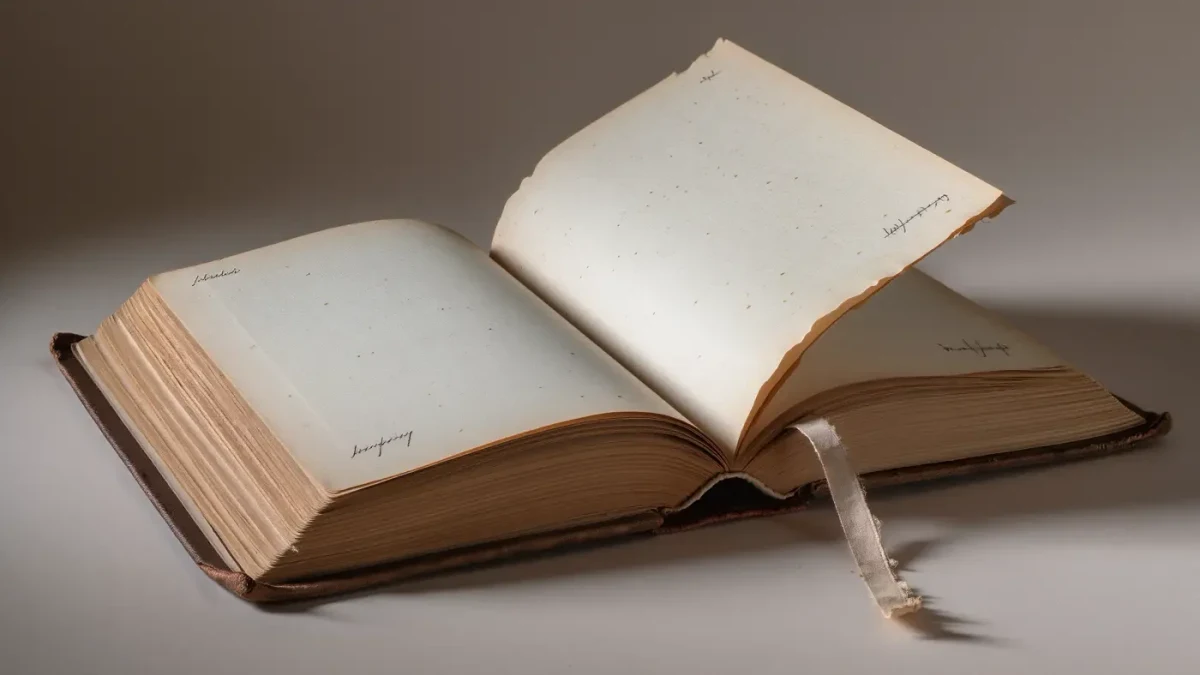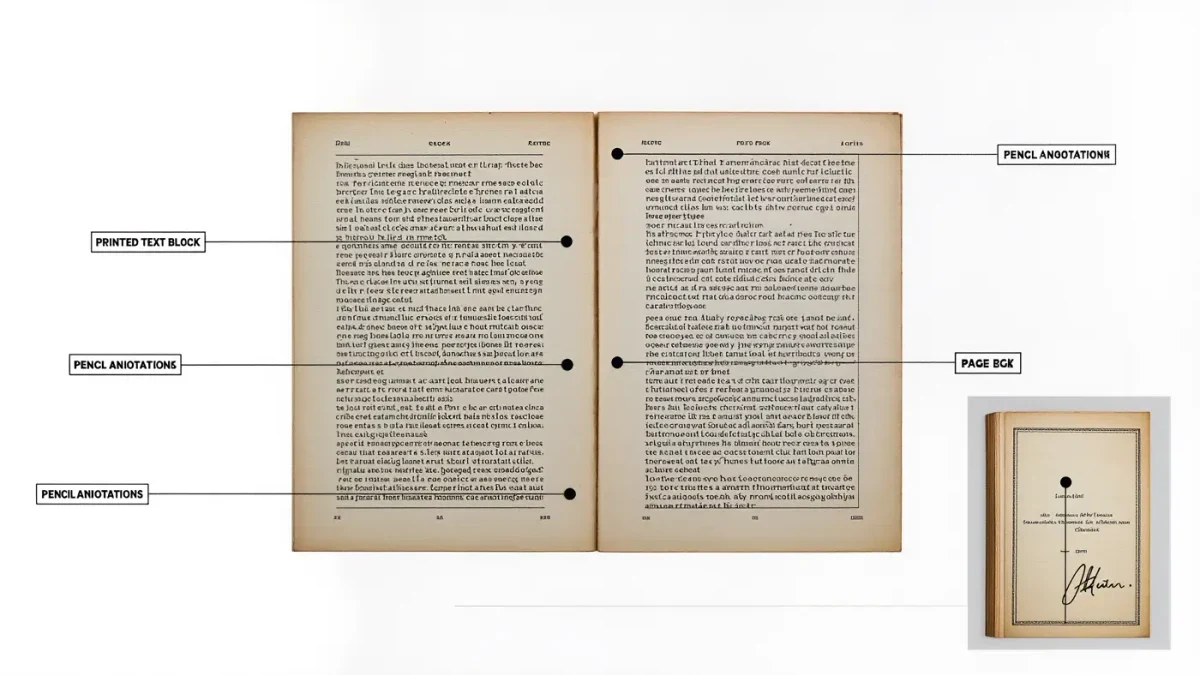
A used hymnal is two texts: the printed one, and the pencil one in the margins. The study of that second text has a documentary history — H. J. Jackson’s Marginalia (2001) is its standard account — and religious books, annotated by generations of owners, are the genre’s deepest archive: prayer, argument, and genealogy in the same cheap copy.
The margin begins as architecture. In the twelfth century, the schools around Anselm of Laon assembled the Glossa Ordinaria, the running commentary on scripture that became standard across Latin Christendom; Peter Lombard built his great commentaries on the Psalms and Paul the same way. On the glossed page, the sacred text is shrunk to a block in the center, and the margins and interlinear spaces carry the accumulated authorities — Fathers, councils, earlier teachers. The page is designed as a conversation across centuries, with room left, quite literally, for the next speaker. Medieval reading was marginal by construction; the white space was a pew.
Print changed the direction of flow without ending the conversation. Early printed Bibles kept the glossed layout, commentary still embracing text, and then the Reformation made the margin doctrinal: the Geneva Bible of 1560 shipped with Calvinist notes printed in its margins, the commentary becoming part of the product. Readers answered in the other ink. A page from those decades can hold a printed interpretation, a handwritten objection to it, and a third hand — a grandchild’s? a successor owner’s? — ruling a line under the quarrel. The margin, designed for the next speaker, kept receiving them.
Scribes ended their copies with colophons — notes of name, place, and date, sometimes a price, sometimes a groan. One formula that recurs across manuscripts compares the scribe’s joy at reaching the last line to a traveler’s joy at seeing home again. And where colophons bless, book curses threaten: monastic libraries, whose volumes were chained not because monks distrusted reading but because books cost a village’s income, pronounced anathemas on thieves in terms the thieves could not misunderstand. The genre has its own modern anthology, Marc Drogin’s Anathema! (1983). Ownership was theological before it was legal.
Then there is the signature. “This book belongs to…” — in Latin, in cramped hands, in the front of breviaries and psalters — is one of the few places medieval women and ordinary clergy become individually visible: a nun’s name where her biography otherwise is not. The nineteenth-century family Bible made the function official, printing registers of births, marriages, and deaths between the Testaments, so that the household’s dead lived in the binding with the patriarchs. Scripture as archive; the archive as scripture.
The early modern reader moved the margin into a second book. Commonplace books — notebooks of copied passages under headings — were the trained reader’s engine, and John Locke published a famous indexing method for them in the 1680s. But the margin proper kept its saints. Coleridge’s marginalia, which he wrote compulsively in borrowed and owned books alike, were considered important enough to be edited, in our own time, as volumes of his collected works; Jackson, the scholar who mapped the field, came out of that editorial school. Melville’s pencil has its own catalogue — Merton Sealts documented his library and its markings in Melville’s Reading (1988) — because the whale of Moby-Dick (1851) was fattened on marked-up pages.
Religious books carry the heaviest sediment because they are read the most times by the most hands under the most pressure. A hymnal bought new for a confirmation and sold sixty years later at a church rummage sale; a missal with a name and a first communion date; a paperback Psalter softened by a pocket. The marks go where the need was. Sometimes there is a date and a name and nothing else, and the rest is inference; the inference is usually love or grief, and it is usually right. That is the uncomfortable genius of the secondhand copy: you read it with a ghost’s finger on the page, stopping where they stopped.
Is that eavesdropping? The question is real and it does not resolve. An inscription is a public act — “To Dorothy” was written to be seen by whatever came after Dorothy. A pencil line under a verse of rescue is private, addressed to the book and to the self that needed the verse that morning. The secondhand buyer inherits both without having been left either. Erasing the marks would be vandalism; ignoring them takes discipline; reading them takes nerve. Every used book is a palimpsest of attention, and the ethics of it sit somewhere between honoring a will and opening someone else’s mail.
A pencil outlives its owner.
Jackson’s larger point, made steadily across a career, is evidentiary: readers’ marks are among the only records of how books were actually used. The print run is the publisher’s dream; the marginalia are the reader’s diary. Bibliography can tell you how many copies existed. Only the margins can tell you that one of them was carried through something.
Somewhere, most weekends, a hymnal inscribed “To Dorothy, Confirmation, 1948” is being priced at a dollar for a church rummage sale. A stranger will buy it for the hymns, maybe, or else for the cover. The penciled brackets around Psalm 121 will stay exactly where Dorothy’s hand left them — the second text, still open, still asking to be read by whoever comes next.