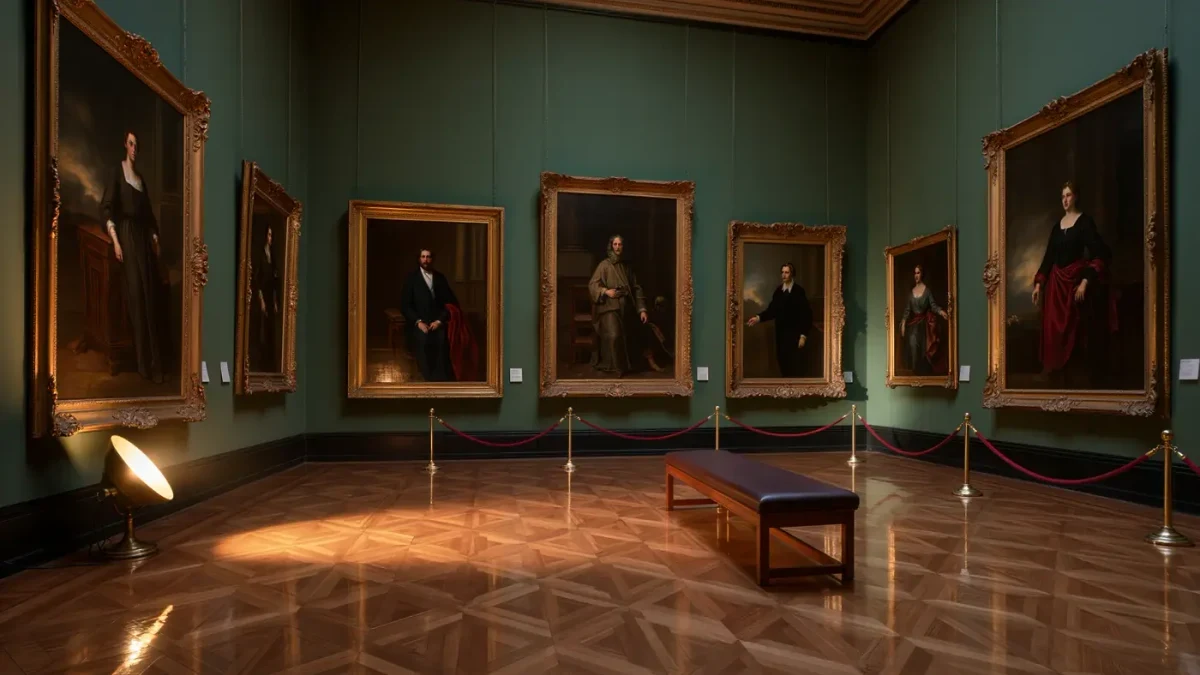
Rembrandt’s biblical work is scattered but visitable: the Rijksmuseum in Amsterdam, the National Gallery in London, the Louvre, the Hermitage and the Mauritshuis hold the landmarks, while the etchings sit in print rooms from New York to Vienna. Belshazzar’s Feast (c. 1635), in the National Gallery, London, shows the method whole: a single verse of Daniel turned into theater.
Which Museums Hold the Biblical Rembrandt?
Amsterdam first, with a caveat: the Rijksmuseum’s Rembrandt galleries are dominated by The Night Watch (1642), which is not biblical at all — it is a civic militia portrait. The museum’s scriptural holdings stand nearby: The Jewish Bride (c. 1665–69), a painting long read as Isaac and Rebecca from Genesis, the small hushed Supper at Emmaus of 1648, and the late Self-Portrait as the Apostle Paul (1661).
Then London, for Belshazzar’s Feast (c. 1635); Frankfurt’s Städel, for the brutal Blinding of Samson (1636); the Louvre, for Bathsheba at Her Bath (1654); the Hermitage, for The Sacrifice of Isaac (1635) and the great late Return of the Prodigal Son (c. 1668); the Mauritshuis in The Hague, for Saul and David, a canvas whose attribution was debated for a generation before conservation and study restored it firmly to Rembrandt. art news coverage.
One absence should be named: Christ in the Storm on the Sea of Galilee (1633), his only seascape, was stolen from the Isabella Stewart Gardner Museum in Boston in 1990 and has never been recovered. The museum still hangs the empty frames — a modern martyrdom of a picture that endures as a label and a gap.
How Did He Read Scripture?
As drama performed by people he could see. Rembrandt painted specific verses rather than generalized holy scenes: the instant the writing appears at Belshazzar’s table (Daniel 5), the moment the disciples wake a sleeping Christ in a sinking boat (Mark 4), the embrace after the prodigal’s long absence (Luke 15). He set them among contemporary faces and untidy clothing, and he returned to the same passages across media and decades — the sacrifice of Isaac is a painting of 1635 in St. Petersburg and an etching of 1655, thirty years deeper into the same worry.
The late work quiets. The Return of the Prodigal Son, painted around 1668, the year before his death, strips the parable to three figures and two hands laid on a bowed back; the blind old father’s face is barely articulated, as if sight had moved somewhere else. Visitors who know only the early swagger usually stop here for a long time.
What Did the Jewish Neighbors Have to Do With It?
Something, and less than old books claimed. From 1639 Rembrandt lived on the Breestraat — the house survives as the Rembrandt House Museum — at the edge of Amsterdam’s Jewish quarter, in a city where Sephardic families had settled after fleeing the Iberian Inquisition. The documentary trace is on the page: he contributed etchings, four in all, to Piedra Gloriosa, a 1655 book by the rabbi and printer Menasseh ben Israel, who worked within walking distance. The Hebrew-style inscription on the wall in Belshazzar’s Feast — its letter forms debated by scholars for generations — belongs to the same curiosity.
What later scholarship has trimmed are the larger romantic claims: that named sitters were his Jewish neighbors, or that The Jewish Bride depicts a couple from the community. That title is a nineteenth-century guess; the subject, if it is Isaac and Rebecca, comes from Genesis 26:8. What stands is proximity itself — an Old Testament painted with unusual attention, a few streets from readers for whom those texts were lived rather than illustrated.
How Should You Plan the Visit?
Amsterdam in one day: the Rijksmuseum for the paintings, then the Rembrandt House for the reconstructed studio and the printing demonstrations that show how the biblical etchings were pulled. London and The Hague pair naturally by train. And because the etchings — among them the Hundred Guilder Print (c. 1649) and The Three Crosses (1653) — exist in multiple impressions, the print rooms of the Metropolitan Museum, the British Museum and the Rijksmuseum hold works on paper that loan exhibitions rarely gather; appointments are usually required, and worth the form.
Frequently Asked Questions
The questions readers send most about Rembrandt and the Bible, answered briefly.
Which is the most famous biblical Rembrandt?
The Return of the Prodigal Son (c. 1668), in the Hermitage, St. Petersburg — painted the year before the artist’s death and the endpoint of most pilgrimages.
Why is The Jewish Bride called that?
The name was invented in the nineteenth century. The painting is usually read as Isaac and Rebecca blessing, from Genesis 26:8 — a scripture subject, not a portrait.
Where can the biblical etchings be seen?
In print rooms, by appointment or in rotation: the Metropolitan Museum, the British Museum and the Rijksmuseum all hold impressions of the major plates, including the Hundred Guilder Print.
What happened to Christ in the Storm on the Sea of Galilee?
It was stolen from the Isabella Stewart Gardner Museum in 1990 with twelve other works and has never been recovered; the museum hangs the empty frames in place.