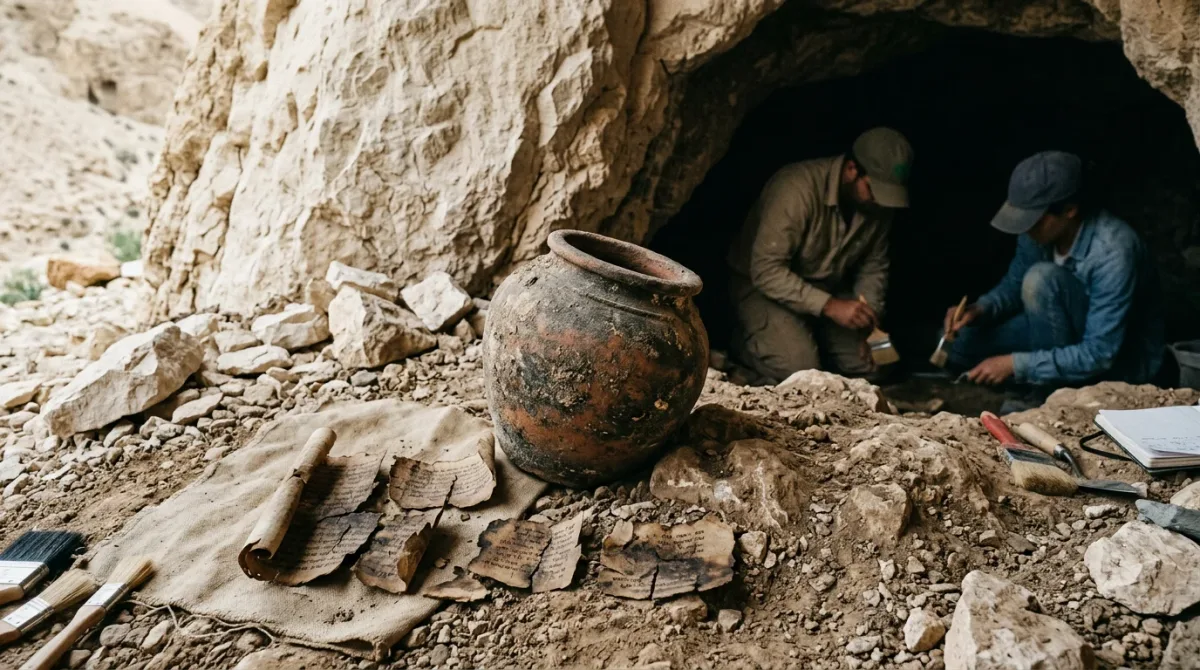
The Dead Sea Scrolls are a collection of roughly 900 manuscripts on parchment and papyrus, recovered from eleven caves near the ruins of Qumran on the Dead Sea’s northwest shore, dating from the third century B.C.E. to 68 C.E. — among them the oldest surviving copies of books later canonized in the Hebrew Bible, older than any previously known biblical manuscript by close to a thousand years.
Most of what survives is fragmentary rather than intact scroll, and reading the collection well means starting with where it came from, what it holds, and what it changed.
When were the Dead Sea Scrolls discovered?
A Bedouin shepherd found the first scrolls in spring 1947, in a cave in the cliffs above the Dead Sea near the ruins of Qumran, later designated Cave 1. A dealer known as Kando bought scrolls from the initial find and sold some to a Hebrew University scholar and others to a Syrian Orthodox archbishop, who carried them to the American School of Oriental Research; between 1949 and 1956, archaeologists and local Bedouin located ten more caves in the surrounding hills, yielding fragments of an estimated 800 to 900 manuscripts in total.
What do the scrolls actually contain?
About 230 of the manuscripts are copies of books that would become the Hebrew Bible — every book except Esther — including a nearly complete Isaiah scroll. The rest range widely: the Community Rule, a set of guidelines for an ascetic religious commune; the Hymns of Thanksgiving; the War Scroll, describing an apocalyptic final battle; the Genesis Apocryphon, which retells and expands Genesis narratives; biblical commentaries known as pesharim; and the Copper Scroll, an inventory of buried treasure unlike anything else in the collection. Related finds elsewhere along the Dead Sea, dated 132 to 135 C.E., include documents from the Bar Kokhba revolt against Rome — dated administrative records that have since become valuable evidence for historians working on the later Roman and Talmudic periods.
What languages are they written in?
Hebrew dominates the collection, with roughly fifteen percent of the texts in Aramaic and a smaller number in Greek. Scribes generally used a standard square Hebrew book-hand, though some copyists switched to an older, paleo-Hebrew script specifically to write the Tetragrammaton, the four-letter divine name, setting it visually apart from the surrounding text — a small scribal choice that signals how carefully these copyists handled the divine name even in an otherwise ordinary manuscript hand.
How old are the scrolls, and how do scholars know?
Dating rests on a combination of methods: paleography, or the study of how Hebrew and Aramaic letterforms changed over centuries, and physical testing of the materials themselves. Carbon-14 analysis of the linen wrapping one of the Isaiah scrolls placed it at roughly 100 B.C.E. Pottery and coins recovered from the Qumran site itself range from about 160 B.C.E. to 68 C.E., bracketing the community’s occupation of the site up to the period of the First Jewish-Roman War.
Why did it take decades to publish all the scrolls?
The original international team that received publication rights numbered only a dozen scholars, and for decades much of the collection stayed effectively closed to outside researchers. That changed only around 1992, when the Huntington Library in California released its set of reference photographs of the fragments, breaking the restriction and expanding the working research team from roughly a dozen scholars to about fifty. The move accelerated publication of texts that had sat unedited for more than forty years and remains a frequently cited case study in debates over access to ancient manuscripts.
Why do the scrolls matter for reading the Bible today?
Before 1947, the earliest complete Hebrew Bible manuscripts dated from the ninth and tenth centuries C.E. The biblical texts among the scrolls turned out to closely resemble that much later, standardized Masoretic Text, evidence of a long tradition of careful, stable copying. At the same time, some scroll copies show scribes making deliberate changes as they worked, a reminder that the biblical text did not arrive as a single fixed document but was transmitted, and occasionally reshaped, by the hands that preserved it. The non-biblical scrolls, meanwhile, opened a direct window onto a Jewish religious community in the late Second Temple period — the same era in which Jesus of Nazareth lived — giving historians primary evidence for currents of thought that fed into both Rabbinic Judaism and early Christianity.
Digitized images of the scrolls, drawn from the collection the Israel Antiquities Authority makes available online, are free to browse fragment by fragment, a slower way into the material than any summary allows.
Frequently asked questions
| Question | Answer |
|---|---|
| Where are the Dead Sea Scrolls kept today? | The Israel Antiquities Authority holds custody of the physical fragments, with major pieces displayed at the Shrine of the Book at the Israel Museum in Jerusalem. High-resolution images of the full collection are digitized and searchable through the Leon Levy Dead Sea Scrolls Digital Library. |
| Are the Dead Sea Scrolls part of any religious canon? | No single scroll defines a canon. The collection includes copies of books later canonized as the Hebrew Bible alongside sectarian texts, such as the Community Rule and War Scroll, that were never adopted into any tradition’s scripture. |
| Who wrote the Dead Sea Scrolls? | No single author or scribe produced them; they are the accumulated library of a Second Temple-era Jewish community, long associated with the Qumran settlement, copied and composed by many hands over roughly three centuries. |
| Can the public view the Dead Sea Scrolls? | Yes. Digitized images of the fragments are publicly viewable online through the Israel Antiquities Authority’s digital library, and select physical scrolls have traveled to museum exhibitions, including a documented 1993 loan exhibition at the Library of Congress in Washington, D.C. |
For a related faith news perspective, read AI Dating Pushes Some Dead Sea Scrolls a Century Older.
For more context, read Comparing Translations of the Tao Te Ching.