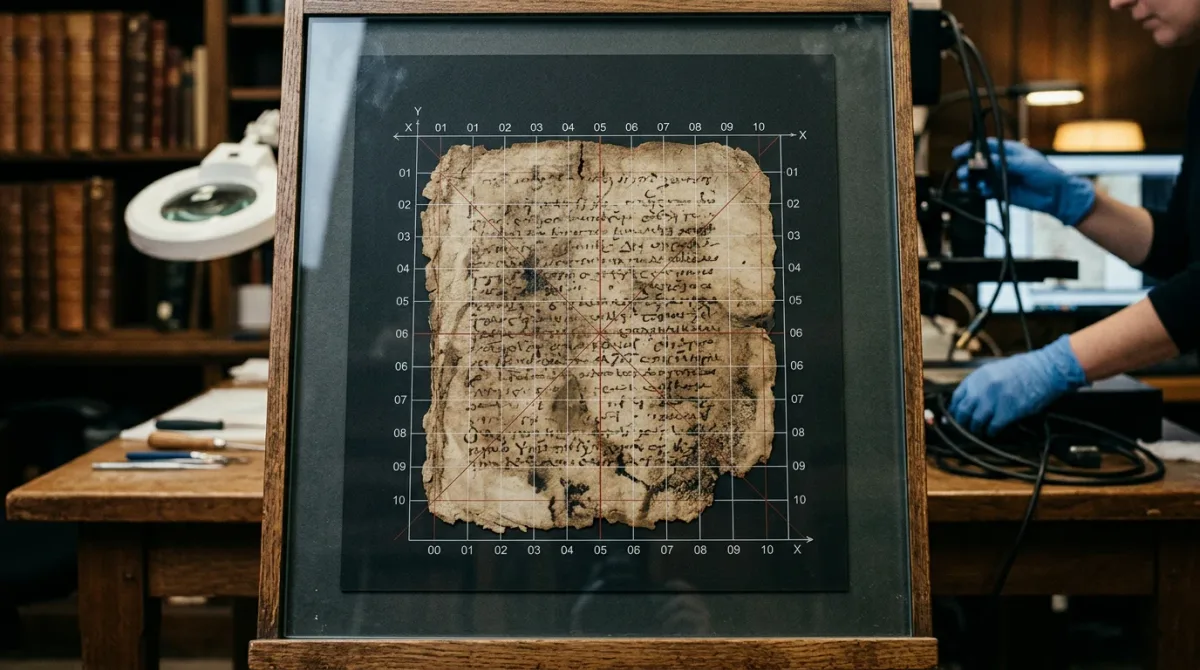
Some of the Dead Sea Scrolls — the Hebrew Bible manuscripts recovered from caves near Qumran starting in 1947 — are as much as a century older than scholars had assumed, according to a study published in the journal PLOS One on June 4, 2025. The finding rests on a new pairing of radiocarbon dating with an AI model trained to read handwriting style.
The project, led by Mladen Popović of the University of Groningen, first re-ran radiocarbon tests on thirty manuscripts using cleaner methods; earlier Cold War-era tests, it turned out, had been skewed by castor oil that conservators applied in the 1950s to make the parchment legible. Most of the thirty came back older than expected. The team then used those corrected dates to train an AI system, nicknamed Enoch, to estimate age from letterforms alone — and set it loose on 135 more scrolls that had never been carbon-dated. This is, in effect, the wider run of manuscript and translation-dating news that this category tracks.
Two cases stand out. A fragment carrying verses from the Book of Daniel, long placed a generation after its presumed author, now reads as contemporary with him. A manuscript of Ecclesiastes previously dated on paleographic grounds to 175–125 BCE was reassigned by Enoch to roughly 300–240 BCE — pushing it back by as much as a century, Popović told CNN.
Outside scholars were cautiously impressed rather than persuaded outright. Charlotte Hempel of the University of Birmingham called the narrower dating window "extremely exciting" if it holds up; Lawrence Schiffman of New York University noted it remains unclear whether the method will prove reliable on manuscripts that have never been carbon-dated at all. Brent Seales of the University of Kentucky, assessing the computational side, called the approach rigorous but noted the sample sizes are still small.
Why it matters for readers of sacred texts: paleography — the study of handwriting style — has quietly underwritten most dating of the scrolls since the 1990s, and with it, timelines for when parts of the Hebrew Bible took the shape we now read. A method that narrows or revises those dates, even by decades, touches how scholars reconstruct the transmission of scripture itself, independent of anyone's tradition or belief. The full study and its data are open access.