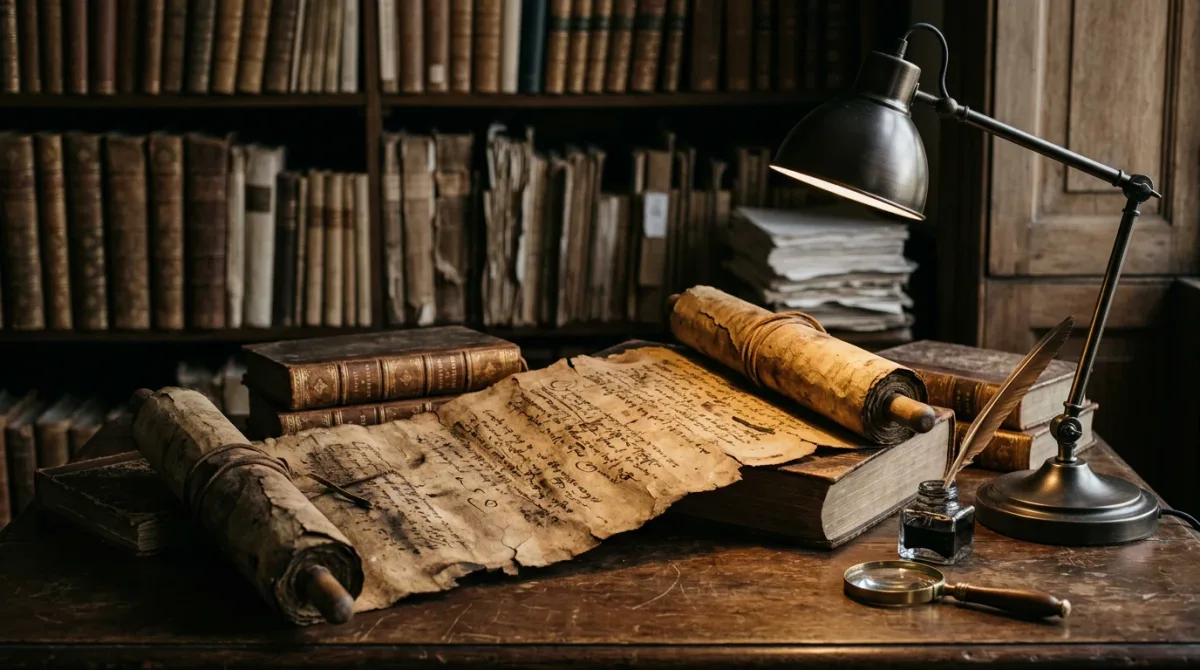
The Great Isaiah Scroll, copied by hand around 125 BCE and pulled from a cave above the Dead Sea in the autumn of 1947, is roughly a thousand years older than any Hebrew Bible manuscript known before its discovery — a single find that collapsed a millennium of textual darkness onto one long strip of parchment, according to the Israel Museum's Digital Dead Sea Scrolls project. It is also, still, the most complete: 734 centimeters of continuous text, nearly the whole book of Isaiah in one unbroken hand, unrolled from a jar where it had waited since before the Second Temple fell.
The story of how it traveled from that jar to a climate-controlled case in Jerusalem is, in its own way, as instructive as the text itself: a case study in how ancient testimony survives, changes hands, gets sorted, and finally gets read. Textual critics prize finds like this precisely because they let a later copy be checked against something a scribe actually held two thousand years ago, rather than against another later copy.
A young shepherd from the Ta'amireh Bedouin tribe found the cave while searching for a stray animal, according to the account published by the Israel Antiquities Authority's Leon Levy Dead Sea Scrolls Digital Library. Inside were large clay jars holding ancient manuscripts; the initial haul came to seven scrolls, sold on to antiquities dealers the record identifies as Kando and Salahi. News of the find moved slowly at first, through a market built for discretion rather than speed.
Access to that comparison once required a research visa and a specialist's darkroom print; it no longer does. The Israel Antiquities Authority describes its digital library as built on advanced imaging technology precisely so that "the oldest known copies of biblical texts" would be, in the agency's own phrase, "accessible to the public for the first time" — a claim as much about how reading now works as about the scroll itself. A reader in any time zone can call up the same high-resolution image a curator uses, letter by letter, without ever touching the parchment.
Professor Eliezer Lipa Sukenik of Hebrew University, who bought three of the seven scrolls from Salahi, recorded the moment in his diary in words the IAA still quotes: "I was privileged by destiny to gaze upon a Hebrew Scroll which had not been read for more than 2,000 years." The remaining four scrolls passed through a dealer connected to Archbishop Samuel and, after an advertisement placed in the Wall Street Journal, reached Sukenik's son, the archaeologist Yigael Yadin, who purchased them in 1954.
By then the search had already moved well past the first cave. Archaeologists Roland de Vaux and Gerald Lankester Harding led excavation teams that eventually opened eleven caves around Qumran, recovering roughly 900 distinct manuscripts. Cave 4, found in 1952, proved the richest: it yielded about seventy-five percent of everything Qumran gave up, though mostly in fragments rather than intact scrolls.
Keeping nearly a thousand fragmentary texts straight without losing the thread required a filing system, and it is laid out in detail by Yale University Library's research guide to the collection: each manuscript carries a two-part designation, a number fixing its cave of origin and a name identifying the composition, so the great Isaiah scroll from Cave 1 is catalogued as 1QIsa, with a superscript marking it as the first of two Isaiah copies found there. It is a system built for triage, not reverence, and it has held for seven decades.
Publication took decades, and at times the pace itself became the story the field would rather not repeat: an international scholarly team was appointed in 1953, but broad public access to the corpus did not arrive until the Israel Antiquities Authority accelerated the project in the early 1990s under chief editor Emanuel Tov, expanding the editorial team to roughly a hundred scholars. The majority of official editions were finally in print by 2001.
The Great Isaiah Scroll itself never had to wait that long for attention — it was photographed within months of its discovery in 1948 — but the fuller sense of what it meant took the whole field decades to absorb. Its very survival showed that the text later fixed as the Masoretic tradition had already taken essentially its familiar shape a full millennium earlier. Professors Peter Flint of Trinity Western University and Eugene Ulrich of the University of Notre Dame later produced the standard English translation of its opening five chapters, work now displayed beside the scroll's digital facsimile.
The scroll itself lives at the Shrine of the Book, the Israel Museum's dedicated wing in Jerusalem, under the care of Dr. Adolfo D. Roitman, the museum's Lizbeth and George Krupp Curator of the Dead Sea Scrolls. What visitors see coiled beneath the building's white dome is usually a facsimile; the original, parchment thin enough to survive two thousand years folded in a jar, is too fragile for continuous light. Seven hundred thirty-four centimeters, sixty-six chapters, one continuous hand: the length of it is the argument. Before 1947, no one reading Isaiah in Hebrew was reading anything older than the Middle Ages. After it, they were reading something a Judean scribe had finished before Rome built the Colosseum — and it said, with only minor variation, what the tradition had always said it said. That is the quiet, unglamorous payoff of the whole find: not a revelation that overturned the text, but a witness old enough to confirm that nothing essential had been lost in the copying.
For a related faith news perspective, read AI Dating Pushes Some Dead Sea Scrolls a Century Older.